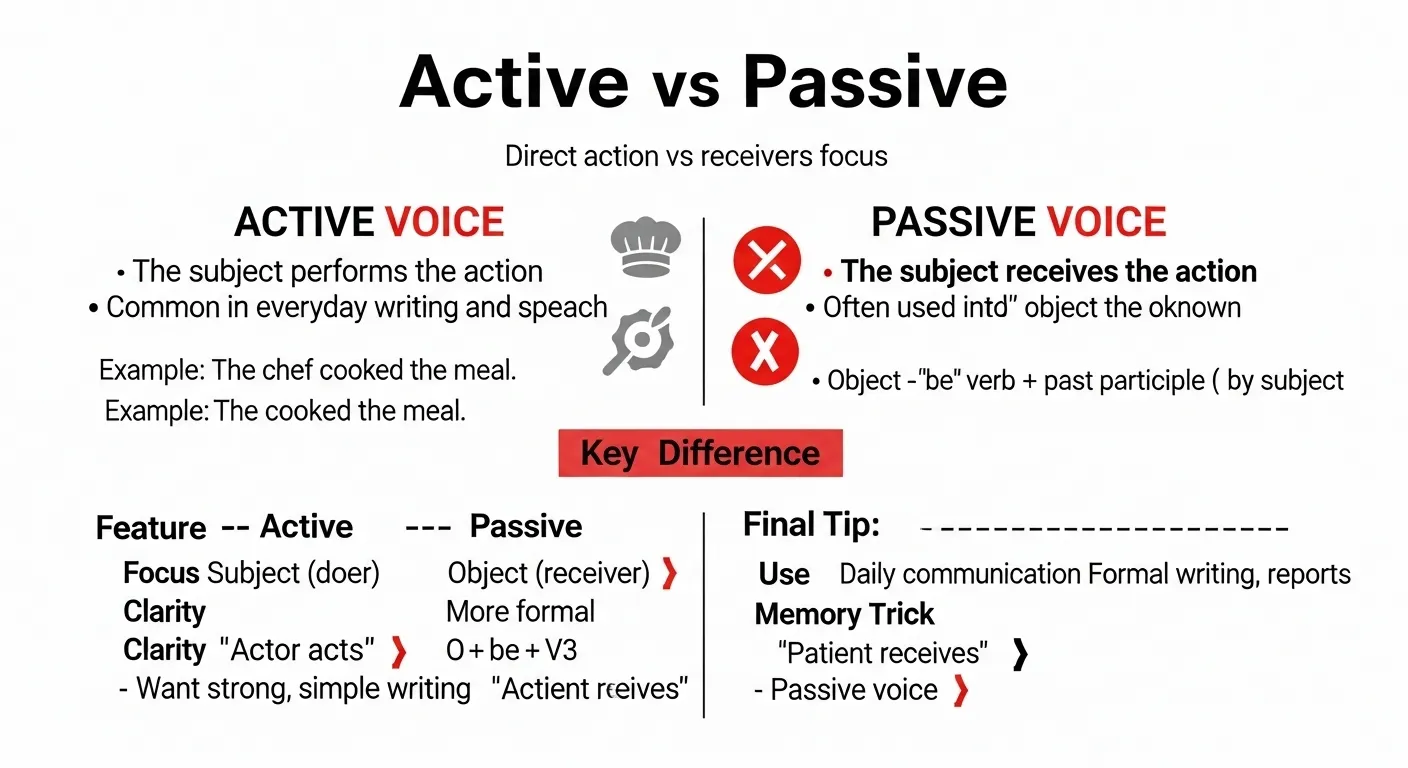
The difference between active and passive mainly about how actions are expressed in a sentence.
In English grammar, active voice shows that the subject performs the action, while passive voice shows that the subject receives the action.
Understanding the difference between active and passive helps improve writing clarity, sentence structure, and communication skills. In simple terms, active is direct and strong, while passive is indirect and formal.
✍️ Key Difference Between the Both
The main difference lies in who performs the action.
- Active Voice: Subject does the action
- Passive Voice: Subject receives the action
Examples:
- Active: The teacher explains the lesson.
- Passive: The lesson is explained by the teacher.
📚 Why Is Their Difference Important?
Understanding the difference between active and passive is important in writing, speaking, exams, and professional communication. Active voice makes sentences clear and powerful, while passive voice is useful in formal writing, reports, and scientific texts. Knowing the difference between active and passive helps you choose the right style for the right situation.
🔊 Pronunciation (US & UK)
| Term | US Pronunciation | UK Pronunciation |
| Active | /ˈæk.tɪv/ | /ˈæk.tɪv/ |
| Passive | /ˈpæs.ɪv/ | /ˈpæs.ɪv/ |
➡️ Now let’s explore the detailed difference between active and passive step by step.
🌐 Difference Between Active and Passive
1️⃣ Sentence Structure
Active voice: Subject → Verb → Object
Passive voice: Object → Verb → Subject
Examples:
- Active: She writes a letter.
- Passive: A letter is written by her.
2️⃣ Focus
Active voice focuses on the subject.
Passive voice focuses on the action or object.
Examples:
- Active: The chef cooked the meal.
- Passive: The meal was cooked by the chef.
3️⃣ Clarity
Active voice is clearer and more direct.
Passive voice is more formal and indirect.
Examples:
- Active: They built the house.
- Passive: The house was built by them.
4️⃣ Usage
Active voice is used in daily conversation and writing.
Passive voice is used in formal writing and reports.
Examples:
- Active: The dog chased the cat.
- Passive: The cat was chased by the dog.
5️⃣ Verb Form
Active voice uses simple verb forms.
Passive voice uses “be + past participle.”
Examples:
- Active: He eats food.
- Passive: Food is eaten by him.
6️⃣ Responsibility
Active voice clearly shows who is responsible.
Passive voice may hide or reduce focus on the doer.
Examples:
- Active: The manager approved the report.
- Passive: The report was approved.
7️⃣ Formality
Active voice is less formal.
Passive voice is more formal and academic.
Examples:
- Active: We completed the project.
- Passive: The project was completed.
8️⃣ Length of Sentence
Active voice is shorter.
Passive voice is longer.
Examples:
- Active: She opened the door.
- Passive: The door was opened by her.
9️⃣ Tone
Active voice sounds strong and confident.
Passive voice sounds neutral or objective.
Examples:
- Active: The company launched a product.
- Passive: A product was launched by the company.
🔟 Usage in Writing Style
Active voice preferred in SEO, blogs, and storytelling.
Passive voice preferred in scientific and legal writing.
Examples:
- Active: Researchers discovered a cure.
- Passive: A cure was discovered by researchers.
🧠 Nature and Behaviour of Both Active and Passive
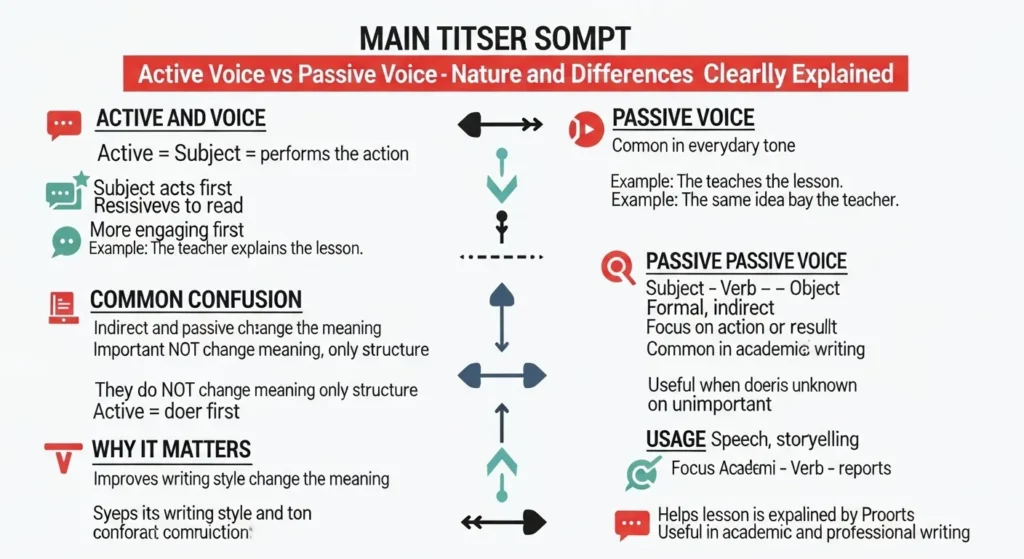
Active Voice
- Direct and clear
- Strong tone
- Common in speech
Passive Voice
- Indirect and formal
- Focus on action/result
- Common in academic writing
📊 Comparison Chart
🌐 Difference Between Active and Passive
| Feature | Active Voice ✍️ | Passive Voice 📄 |
| Structure | Subject performs action | Subject receives action |
| Focus | Subject | Object / action |
| Clarity | Clear and direct | Less direct |
| Verb Form | Simple verb | be + past participle |
| Usage | Daily communication | Formal writing |
| Tone | Strong | Neutral |
| Length | Short | Longer |
| Responsibility | Clearly shown | May be hidden |
| Style | Informal / general | Academic / formal |
| Example | She wrote a book | A book was written by her |
⚖️ Which Is Better in What Situation?
Active Voice
Best for blogs, storytelling, and daily communication because it is clear and engaging.
Passive Voice
Best for formal reports, scientific writing, and when the doer is unknown or unimportant.
🎭 Use in Metaphors and Similes
Metaphor example:
- Active voice is a fast-moving river, while passive voice is a calm lake.
Simile example:
- Active voice is like speaking directly to someone, while passive voice is like reporting from a distance.
💬 Connotative Meaning
| Term | Connotation | Example |
| Active | Energy, clarity | It felt active and strong. |
| Passive | Calm, indirect | It sounded passive and soft. |
🗣️ Expressions
- Use active voice for strong writing
- Passive voice used in formal reports
📚 Writing Context
Active and passive voices widely used in:
- English grammar learning
- Academic writing
- Journalism
- Business communication
❔ Frequently Asked Questions
1. What is active voice?
It is when the subject performs the action.
2. What is passive voice?
It is when the subject receives the action.
3. Which is better?
Active voice is generally better for clarity.
4. Can both be used together?
Yes, depending on context.
5. Why passive voice used?
To make sentences formal or focus on the action.
🌍 Importance in Daily Life
Understanding active and passive voice helps improve writing quality, communication clarity, and professional expression.
✍️ Final Words
The difference between active and passive lies in structure and focus. Active voice is direct and strong, while passive voice is formal and indirect. Both important in English grammar and used according to context.
🏁 Conclusion
Knowing the difference between active and passive helps you become a better writer and communicator.
Active voice is best for clarity and engagement, while passive voice is useful for formal and academic writing. Using both correctly improves overall language skills.
Discover More Articles:

Hi, I’m Nabeel Hassan. I love exploring interesting topics and explaining how different things compare with each other. Through my writing, I aim to provide clear, helpful, and easy to read explanations. I cover subjects related to learning, science, technology and general knowledge.