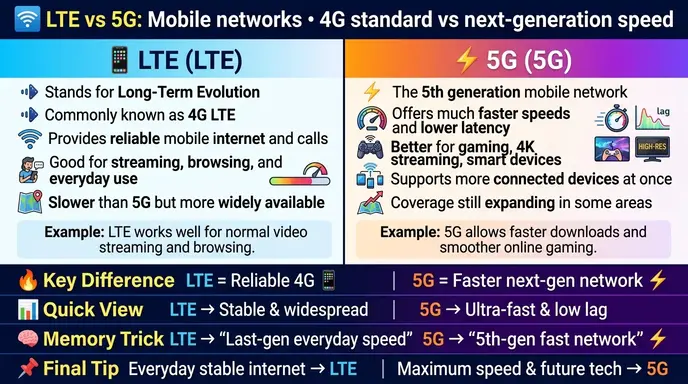
The difference between LTE and 5G is that LTE is a fourth-generation (4G) mobile network technology focused on stable wireless internet and communication, while 5G is a newer fifth-generation network designed for much faster speeds, lower latency, and improved device connectivity.
Many people get confused about the difference between LTE and 5G because both provide mobile internet access on smartphones and other devices. However, they differ in speed, response time, network capacity, and technological capabilities.
If you’ve ever wondered what is LTE vs 5G, which network is faster, or whether upgrading to 5G matters, this guide will clearly explain the difference between LTE and 5G in simple and practical language.
⚡ Quick Answer: Difference Between LTE and 5G
- LTE: 4G wireless network technology designed for reliable mobile internet
- 5G: Newer wireless technology offering faster speeds and lower latency
👉 Example: 5G generally downloads files much faster than LTE.
📖 Definition of LTE and 5G
- LTE: Long-Term Evolution, a widely used 4G mobile communication standard for wireless internet and data transfer.
- 5G: Fifth-generation mobile network technology designed to improve speed, responsiveness, and large-scale connectivity.
🔊 Pronunciation (US & UK)
- LTE: UK /ˌel.tiːˈiː/ | US /ˌel.tiːˈiː/
- 5G: UK /ˌfaɪv ˈdʒiː/ | US /ˌfaɪv ˈdʒiː/
Now let’s understand their differences clearly.
📊 LTE vs 5G Comparison Table
| Feature | LTE | 5G |
| Generation | 4G technology | 5G technology |
| Internet Speed | Fast | Much faster |
| Latency | Higher | Lower |
| Device Capacity | Moderate | Very high |
| Streaming Quality | Good | Excellent |
| Download Speed | Slower than 5G | Faster than LTE |
| Network Efficiency | Strong | More advanced |
| Technology Age | Older | Newer |
🔍 KEY DIFFERENCES EXPLAINED BETWEEN LTE AND 5G
🚀 Speed
5G usually offers significantly faster download and upload speeds than LTE.
👉 Example: Large videos may download faster on 5G networks.
⚡ Latency and Response Time
Latency refers to communication delay between devices and networks. 5G generally has much lower latency than LTE.
👉 Example: Online gaming and video calls may feel more responsive on 5G.
📡 Network Capacity
5G is designed to support many more connected devices simultaneously compared to LTE.
👉 Example: Smart cities and connected devices benefit from 5G capacity.
📱 Technology Generation
LTE belongs to the fourth generation of mobile networks, while 5G is the fifth generation with more advanced infrastructure.
👉 Example: Each generation improves communication technology.
🎮 Performance for Modern Applications
5G supports advanced technologies such as smart automation, high-quality streaming, and low-delay communication more effectively.
👉 Example: Augmented reality applications benefit from low-latency networks.
🌍 Coverage Availability
LTE coverage is currently more widespread in many areas, while 5G coverage continues expanding globally.
👉 Example: Some rural regions may still rely mainly on LTE.
🤔 What Is the Difference Between LTE or 5G in Simple Words?
In simple words, LTE is an older 4G mobile network, while 5G is a newer and faster network technology with better performance and lower delay.
👉 LTE = reliable 4G network
👉 5G = faster next-generation network
🧠 Why Do People Compare LTE and 5G?
Both provide wireless mobile internet and smartphone connectivity.
LTE is commonly known for:
- Stable coverage
- Reliable mobile internet
- Broad availability
- Strong compatibility
5G is commonly known for:
- Faster internet speeds
- Lower latency
- Advanced connectivity
- Better support for modern technology
👉 Users compare them mainly for performance and speed.
🌍 Difference Between LTE and 5G in Real Life
In practical everyday use:
- LTE works well for browsing, streaming, and messaging
- 5G improves high-speed downloads and real-time applications
- Network experience depends on signal strength and coverage
👉 Location can affect performance differences.
⚖️ DIFFERENCE + SIMILARITY TABLE of 5G and LTE
| Feature | LTE | 5G | Similarity |
| Mobile Network | Yes | Yes | Wireless communication |
| Internet Access | Yes | Yes | Mobile connectivity |
| Smartphone Support | Yes | Yes | Cellular technology |
| Streaming Capability | Yes | Yes | Online media access |
| Wireless Data Transfer | Yes | Yes | Internet usage |
| Used Worldwide | Yes | Yes | Communication systems |
| Supports Calls and Apps | Yes | Yes | Mobile functionality |
| Requires Carrier Networks | Yes | Yes | Telecom infrastructure |
This table clearly shows the difference and similarity between difference between LTE and 5G for quick understanding.
❌ Common Mistakes with LTE or 5G
Thinking LTE Is Obsolete
❌ LTE no longer works effectively.
✅ LTE still provides strong and reliable mobile connectivity.
Technology remains widely used.
Assuming 5G Is Always Faster Everywhere
❌ 5G automatically performs better in all locations.
✅ Coverage and signal quality affect actual performance.
Network conditions matter.
Confusing Network Generation with Phone Speed Alone
❌ A phone becomes faster only because of 5G branding.
✅ Device hardware and coverage also influence performance.
Multiple factors matter.
Ignoring Coverage Availability
❌ 5G is fully available everywhere.
✅ Coverage expansion still varies by region.
Location matters.
Believing LTE and 5G Use Completely Different Phones
❌ LTE phones always support 5G automatically.
✅ 5G requires compatible hardware and network support.
Compatibility matters.
🏡 Real Life Examples with LTE and 5G
🎬 Video Streaming
5G may stream high-resolution videos more smoothly in strong coverage areas.
🎮 Online Gaming
Lower latency on 5G can improve gaming responsiveness.
📞 Everyday Smartphone Use
LTE remains reliable for calls, browsing, and messaging.
🏙️ Smart Technology Systems
5G supports advanced connected devices and automation.
🎯 WHEN TO USE EACH
Use LTE When:
✔ Discussing 4G mobile networks
✔ Referring to stable wireless coverage
✔ Talking about traditional high-speed mobile internet
✔ Mentioning broader network availability
Use 5G When:
✔ Discussing next-generation networks
✔ Referring to faster mobile speeds
✔ Talking about lower latency
✔ Mentioning advanced wireless technology
🤯 WHY PEOPLE GET CONFUSED IN LTE AND 5G
- Both provide mobile internet
- Both appear on smartphones
- Both connect devices wirelessly
- Network marketing terms overlap
⚙️ How Tech Experts Understand LTE vs 5G
Technology professionals separate these networks based on:
- Speed capability
- Latency performance
- Device connectivity capacity
- Network infrastructure generation
👉 LTE focuses on strong 4G connectivity, while 5G delivers faster and more advanced communication performance.
🧑💻 EXPERT INSIGHT
In real telecommunications systems, LTE and 5G are closely related because many 5G networks still work alongside existing LTE infrastructure. LTE revolutionized mobile internet by making high-speed wireless communication widely accessible, while 5G expands those capabilities with faster speeds, lower delay, and better support for large numbers of connected devices.
One important insight many people overlook is that actual network experience depends heavily on coverage quality, device compatibility, and local infrastructure. In some areas, strong LTE service may outperform weak 5G signals.
👉 Key insight:
LTE provides reliable 4G connectivity, while 5G introduces faster speeds, lower latency, and more advanced network capabilities.
❓ FAQ Section
❓ What is the difference between LTE and 5G?
LTE is a 4G network technology, while 5G is a newer and faster fifth-generation network.
❓ Is 5G faster than LTE?
Yes, 5G is generally much faster.
❓ Does LTE still work well?
Yes, LTE remains widely used and reliable.
❓ What does LTE stand for?
LTE stands for Long-Term Evolution.
❓ Why is 5G important?
5G improves speed, latency, and device connectivity.
❓ Can LTE phones use 5G?
No, phones need compatible 5G hardware.
❓ Is 5G available everywhere?
Coverage varies depending on region and carrier infrastructure.
❓ Which is better for gaming?
5G may provide lower latency and smoother online gaming.
🏁 Conclusion
The difference between LTE and 5G mainly comes down to speed, latency, and technological advancement. LTE is a reliable 4G mobile network technology that supports modern wireless communication, while 5G is a newer network generation offering faster speeds, lower response times, and better support for advanced digital systems.
Understanding this difference helps users make informed decisions about smartphones, internet performance, and future connectivity. In simple terms, LTE focuses on dependable mobile internet, while 5G pushes wireless technology to a faster and more advanced level.
Once you understand how network generations improve communication systems, the difference between LTE and 5G becomes much easier to recognize.
Discover More Articles:

I’m Owen Parker, and I write articles that focus on explaining the differences between common concepts, tools, and ideas. I enjoy simplifying complex information and turning it into clear comparisons that anyone can understand. My work often covers science , education, technology, and everyday knowledge topics.