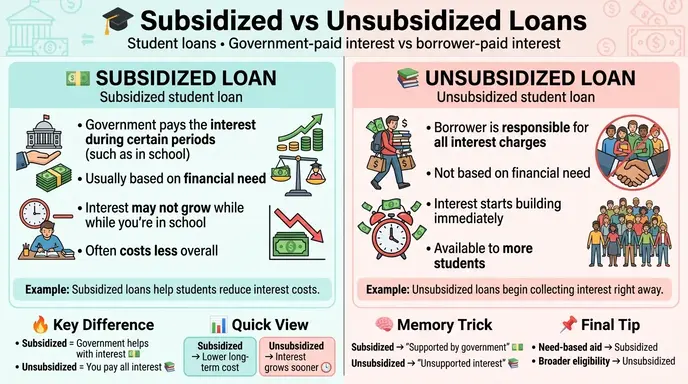
The difference between subsidized and unsubsidized student loans is that subsidized loans have interest paid by the government during certain periods, while unsubsidized loans start collecting interest immediately after the loan is issued.
Many students and parents search for the difference between subsidized and unsubsidized loans because both are common financial aid options for education, yet they affect repayment costs very differently.
In simple words, subsidized loans provide more financial support, while unsubsidized loans place more responsibility on the borrower. Understanding the difference between subsidized and unsubsidized loans helps students make smarter borrowing decisions for college, university expenses, tuition, and long-term repayment planning.
💡 Quick Answer: Difference Between Subsidized or Unsubsidized
Subsidized loans receive government interest support during school periods, while unsubsidized loans begin accumulating interest immediately.
👉 Example: A student with a subsidized loan may avoid interest charges while studying full-time, but a student with an unsubsidized loan continues building interest during college.
📘 Definition of Subsidized and Unsubsidized
- Subsidized Loan: A student loan where the government pays the interest during eligible school and deferment periods.
- Unsubsidized Loan: A student loan where the borrower is responsible for all interest charges from the beginning.
🗣️ Pronunciation (US & UK)
- Subsidized
- US: /ˈsʌb.sə.daɪzd/
- UK: /ˈsʌb.sɪ.daɪzd/
- Unsubsidized
- US: /ˌʌnˈsʌb.sə.daɪzd/
- UK: /ˌʌnˈsʌb.sɪ.daɪzd/
These terms are commonly used in student finance, higher education, financial aid programs, and university funding discussions.
📊 Comparison Table: Subsidized vs Unsubsidized
| Feature | Subsidized | Unsubsidized | Similarity |
| Interest During School | Paid by government | Paid by borrower | Both are student loans |
| Financial Need Requirement | Usually required | Often not required | Both help pay education costs |
| Interest Start Time | After grace/deferment periods | Immediately after disbursement | Both involve repayment |
| Overall Cost | Usually lower total cost | Usually higher total cost | Both may have fixed interest rates |
| Eligibility | Based on financial need | Wider eligibility | Both offered through aid programs |
| Borrower Responsibility | Reduced during school | Full responsibility | Both require repayment later |
| Loan Purpose | Education expenses | Education expenses | Both support college funding |
| Repayment Structure | Similar repayment plans | Similar repayment plans | Both managed through loan systems |
This table clearly shows the difference and similarity between subsidized and unsubsidized loans for quick understanding.
🧠 Key Differences Explained Between Unsubsidized and Subsidized
💰 Interest Responsibility
The biggest difference between subsidized and unsubsidized loans is who pays the interest during school periods.
👉 Example: With subsidized loans, students may avoid extra interest while studying full-time.
🎓 Financial Need Requirement
Subsidized loans are generally based on financial need, while unsubsidized loans are available to a wider range of students.
⏳ Interest Accumulation
Unsubsidized loans start building interest immediately after funds are released.
👉 Example: Even if no payments are made during college, interest continues growing on unsubsidized loans.
💳 Long-Term Cost
Subsidized loans often cost less overall because unpaid interest does not accumulate during approved periods.
🏦 Borrower Flexibility
Unsubsidized loans provide access for students who may not qualify for need-based assistance.
📈 Repayment Impact
Higher accumulated interest can increase total repayment costs for unsubsidized loans.
🎯 Student Financial Planning
Understanding loan type differences helps students reduce future financial pressure after graduation.
🧠 Why Subsidized and Unsubsidized Loans Exist
The difference between subsidized and unsubsidized loans exists because governments and financial aid systems try to support students with different financial situations. Subsidized loans are designed to help students with greater financial need, while unsubsidized loans expand borrowing access more broadly.
🌐 How Education Systems Use Subsidized and Unsubsidized Loans
Universities and government aid programs classify:
- Subsidized loans as need-based assistance
- Unsubsidized loans as general student borrowing options
Organizations like U.S. Department of Education and financial aid offices at colleges manage both loan types to support higher education funding.
📊 Difference + Similarity Table
| Feature | Subsidized | Unsubsidized | Similarity |
| Meaning | Government-supported interest loan | Borrower-paid interest loan | Both fund education |
| Interest Handling | Government pays during approved periods | Student responsible from start | Both accrue repayment obligations |
| Need Requirement | Based on financial need | Usually open to more students | Both require eligibility review |
| Cost Over Time | Lower total borrowing cost | Higher possible repayment cost | Both may include fixed rates |
| Accessibility | Limited by need qualifications | More widely available | Both used for college expenses |
| Repayment | Begins after school periods | Similar repayment structures | Both involve monthly payments |
| Student Benefit | Lower financial pressure | Broader borrowing access | Both support education goals |
| Financial Planning | Better for minimizing interest | Useful when additional funds needed | Both affect long-term finances |
This table clearly shows the difference and similarity between subsidized and unsubsidized loans for quick understanding.
📚 Deep Explanation: Why Interest Matters So Much
Interest determines how much extra money borrowers repay over time. In subsidized loans:
- Government covers interest during approved periods
- Loan balance grows more slowly
- Total repayment cost may stay lower
In unsubsidized loans:
- Interest starts immediately
- Unpaid interest can accumulate
- Long-term repayment costs may increase
👉 Example:
Two students borrow the same amount, but the student with an unsubsidized loan may owe more after graduation because interest built up during school years.
⚠️ Common Mistakes with Difference Between Subsidized and Unsubsidized
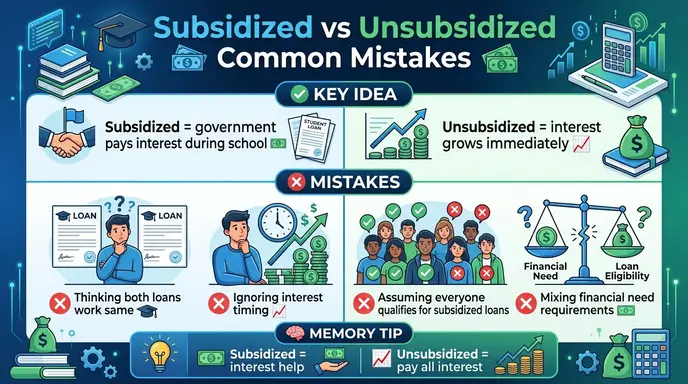
Thinking Both Loans Work the Same Way
❌ Subsidized and unsubsidized loans handle interest identically.
✅ Interest rules differ significantly between the two loan types.
Ignoring Interest Growth
❌ Unsubsidized loans do not build interest during school.
✅ Interest starts accumulating immediately.
Assuming Everyone Qualifies for Subsidized Loans
❌ All students automatically receive subsidized loans.
✅ Subsidized loans usually require financial need eligibility.
Confusing Lower Payments with Lower Costs
❌ Delaying payments always reduces total loan cost.
✅ Accumulated interest may increase overall repayment.
Using Terms Incorrectly
❌ Subsidized loans mean the borrower pays all interest from day one.
✅ Government support covers interest during approved periods.
Believing Loan Type Does Not Matter
❌ Loan category has little effect on future finances.
✅ Loan structure strongly impacts repayment totals and budgeting.
🧑💼 Real Life Examples with Subsidized and Unsubsidized Loans
- Undergraduate students using subsidized loans for tuition
- Graduate students relying more on unsubsidized loans
- Financial aid packages combining both loan types
- Students paying interest early on unsubsidized loans
- College budgeting based on loan repayment expectations
- Borrowers comparing long-term loan costs before accepting aid
🎯 When to Choose Subsidized or Unsubsidized Loans
- Lower long-term interest costs → subsidized
- Need-based financial support → subsidized
- Additional borrowing access → unsubsidized
- Covering remaining tuition gaps → unsubsidized
- Reducing repayment pressure → subsidized
- Flexible borrowing eligibility → unsubsidized
🤔 Why People Get Confused in Subsidized and Unsubsidized
- Both are student loans
- Names sound very similar
- Financial aid letters often include both together
- Interest rules can seem complicated for beginners
- Students focus on borrowing amount instead of repayment structure
🧠 How Financial Aid Systems Understand Subsidized and Unsubsidized Loans
Financial aid systems classify:
- Subsidized loans as need-based support
- Unsubsidized loans as broader borrowing assistance
Loan systems calculate:
- Interest accumulation
- Repayment schedules
- Borrower eligibility
- Financial need status
This helps colleges and governments distribute educational funding more effectively.
🧠 Expert Insight
The difference between subsidized and unsubsidized loans can significantly affect long-term student debt. Subsidized loans generally provide stronger financial protection because interest support reduces repayment pressure during education periods.
In practical financial planning, many students prioritize subsidized loans first before considering unsubsidized borrowing to reduce future repayment costs.
❓ FAQ:
1. What is the main difference between subsidized and unsubsidized loans?
Subsidized loans receive government interest support during certain periods, while unsubsidized loans do not.
2. Do unsubsidized loans gain interest during college?
Yes, interest begins accumulating immediately.
3. Are subsidized loans based on financial need?
Yes, they are usually need-based.
4. Which loan usually costs less overall?
Subsidized loans often cost less because of reduced interest accumulation.
5. Can students receive both loan types?
Yes, many students receive both in financial aid packages.
6. Do both loans require repayment?
Yes, both must eventually be repaid.
7. Why do unsubsidized loans exist?
They provide broader access to education funding for students who may not qualify for subsidized aid.
🧾 Conclusion
The difference between subsidized and unsubsidized loans mainly comes from interest responsibility, financial need requirements, and long-term repayment costs. Subsidized loans provide government-supported interest relief during approved education periods, while unsubsidized loans require borrowers to handle all interest charges from the beginning.
Understanding the difference between subsidized and unsubsidized loans helps students make better borrowing decisions, reduce future debt pressure, and plan educational finances more effectively. Once you connect subsidized loans with government interest support and unsubsidized loans with borrower responsibility, the distinction becomes much easier to understand in student financial planning.
Discover More Articles:

I’m Owen Parker, and I write articles that focus on explaining the differences between common concepts, tools, and ideas. I enjoy simplifying complex information and turning it into clear comparisons that anyone can understand. My work often covers science , education, technology, and everyday knowledge topics.