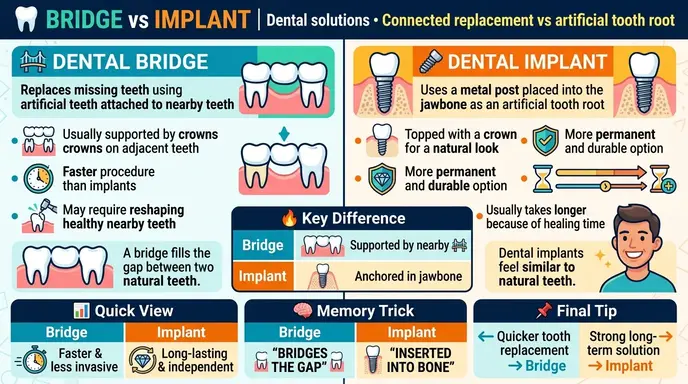
The difference between bridge and implant is that a dental bridge replaces missing teeth by using nearby teeth for support, while a dental implant replaces a missing tooth with an artificial root placed directly into the jawbone.
Many patients search for the difference between bridge and implant because both are common tooth replacement options, yet they differ in procedure, durability, structure, healing process, and long term oral care.
In simple words, a bridge relies on surrounding teeth for support, while an implant stands independently inside the jawbone like an artificial tooth root. Understanding the difference between bridge and implant helps patients better compare dental restoration choices and discuss treatment plans with dental professionals.
💡 Quick Answer: Difference Between Bridge or Implant
A bridge uses nearby teeth to support an artificial tooth, while an implant uses a titanium post placed in the jawbone to support the replacement tooth independently.
👉 Example:
A patient missing one tooth may choose a bridge connected to neighboring teeth, while another may select a dental implant placed directly into the jawbone.
📘 Definition of Bridge and Implant
- Dental Bridge: A dental restoration that replaces missing teeth by attaching artificial teeth to nearby supporting teeth.
- Dental Implant: A dental replacement system where a titanium post is surgically placed into the jawbone to support an artificial tooth.
🗣️ Pronunciation (US & UK)
- Bridge
- US: /brɪdʒ/
- UK: /brɪdʒ/
- Implant
- US: /ɪmˈplænt/
- UK: /ɪmˈplɑːnt/
These terms are commonly discussed in dentistry, cosmetic dental care, restorative treatment, oral surgery, and tooth replacement planning.
📊 Comparison Table: Bridge vs Implant
| Feature | Bridge | Implant | Similarity |
| Main Structure | Supported by nearby teeth | Supported by jawbone implant post | Both replace missing teeth |
| Tooth Support | Uses adjacent teeth | Independent support system | Both restore chewing function |
| Surgical Requirement | Usually less surgical work | Requires surgical placement | Both involve dental procedures |
| Jawbone Interaction | Does not replace tooth root | Replaces artificial root function | Both improve appearance |
| Longevity | May require replacement over time | Often longer lasting | Both require oral care |
| Healing Time | Usually faster process | Longer healing period possible | Both involve dental appointments |
| Neighboring Teeth Impact | Nearby teeth often reshaped | Neighboring teeth remain untouched | Both improve smile restoration |
| Cost Pattern | Often lower upfront cost | Often higher upfront cost | Both vary by treatment complexity |
This table clearly shows the difference and similarity between bridge and implant for quick understanding.
🧠 Key Differences Explained Between Implant and Bridge
🦷 Support Structure
The biggest difference between bridge and implant is support. A bridge depends on neighboring teeth, while an implant is anchored directly into the jawbone.
👉 Example:
A bridge may attach crowns to adjacent teeth to hold the artificial tooth in place.
🔩 Artificial Root Replacement
Dental implants replace the missing tooth root, while bridges only replace the visible tooth portion.
🩺 Surgical Procedure
Implants usually involve oral surgery to place a titanium post into the jawbone.
⏳ Treatment Timeline
Bridges are often completed faster, while implants may require healing time before the final crown placement.
👉 Example:
Implant healing can take several months in some cases.
🦴 Jawbone Health
Implants help stimulate the jawbone similarly to natural tooth roots.
😁 Impact on Nearby Teeth
Bridges may require reshaping healthy adjacent teeth, while implants often leave neighboring teeth untouched.
💰 Cost Differences
Implants often involve higher initial costs because of surgical placement and additional procedures.
🧠 Why Bridge and Implant Get Confused
The difference between bridge and implant becomes confusing because both:
- Replace missing teeth
- Improve appearance
- Restore chewing ability
- Use crowns or artificial teeth
- Are common restorative dental treatments
Many patients compare both when deciding between tooth replacement options.
🌐 How Dental Systems Use Bridge and Implant Treatments
Dental healthcare systems classify:
- Bridges as tooth supported restorations
- Implants as surgically placed root replacement systems
Organizations like American Dental Association and dental education systems discuss:
- Bone support
- Oral hygiene
- Long term durability
- Restoration planning
- Cosmetic outcomes
Modern dental imaging systems and digital scanning technology also help dentists evaluate bridge and implant suitability.
📊 Difference + Similarity Table
| Feature | Bridge | Implant | Similarity |
| Meaning | Tooth supported restoration | Jawbone supported replacement tooth | Both replace missing teeth |
| Main Support | Adjacent teeth | Titanium implant post | Both restore smiles |
| Surgical Need | Usually limited surgery | Surgical placement required | Both involve dental treatment |
| Tooth Root Replacement | Does not replace root | Replaces artificial root function | Both support chewing ability |
| Healing Time | Faster completion common | Longer healing process possible | Both need follow up care |
| Effect on Nearby Teeth | Nearby teeth may be reshaped | Nearby teeth remain natural | Both improve oral function |
| Longevity Pattern | May need replacement sooner | Often longer lasting | Both require maintenance |
| Cost Style | Lower upfront expense common | Higher initial investment common | Both vary by patient case |
This table clearly shows the difference and similarity between bridge and implant for quick understanding.
🦷 Deep Explanation: Why Dental Implants Feel More Natural
Dental implants are designed to imitate natural tooth structure:
- Titanium post acts like a tooth root
- Jawbone supports the implant
- Crown attaches above the gumline
- Chewing pressure transfers through the implant
👉 Example:
Many patients describe implants as feeling closer to natural teeth after healing.
Bridges, however:
- Sit above the gums
- Depend on nearby teeth
- Do not replace root structure
This structural difference is why implants are often considered more independent and bone supportive solutions.
⚠️ Common Mistakes with Difference Between Bridge and Implant
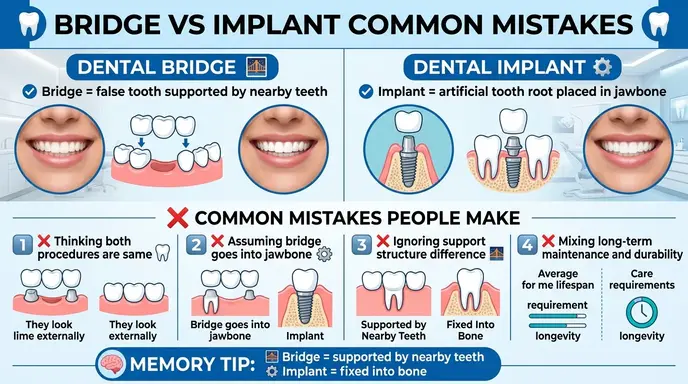
Thinking Bridges and Implants Are the Same Procedure
❌ Dental bridges and implants work exactly the same way.
✅ Bridges use nearby teeth, while implants use jawbone support.
Ignoring Jawbone Differences
❌ Both options replace tooth roots.
✅ Only implants replace artificial root function.
Assuming Implants Do Not Need Care
❌ Dental implants never require oral hygiene.
✅ Implants still need proper cleaning and dental care.
Using Terms Incorrectly
❌ A bridge is surgically inserted into the jawbone.
✅ Implants involve jawbone placement, not bridges.
Ignoring Treatment Timeline Differences
❌ Implants and bridges always take the same amount of time.
✅ Implant healing may require several months.
Believing One Option Fits Everyone
❌ Every patient should automatically choose implants.
✅ Treatment depends on bone health, cost, and dental condition.
🧑⚕️ Real Life Examples with Bridge and Implant
- Replacing a missing front tooth with an implant
- Using a bridge after tooth extraction
- Cosmetic smile restoration procedures
- Jawbone supported dental implants
- Multi tooth bridge restorations
- Implant supported crowns improving chewing function
🎯 When Dentists May Recommend Bridge or Implant
- Healthy jawbone available → implant may be considered
- Faster restoration needed → bridge may be chosen
- Avoiding surgery → bridge often preferred
- Protecting nearby healthy teeth → implant may help
- Multiple missing teeth → bridge systems sometimes used
- Long term tooth root replacement → implant commonly recommended
🤔 Why People Get Confused in Bridge and Implant
- Both replace missing teeth
- Similar cosmetic appearance
- Both use crowns
- Dental terminology overlaps
- Patients focus mainly on visible tooth replacement
🧠 How Dental Systems Understand Implant or Bridge Treatments
Dental systems analyze:
- Jawbone health
- Gum condition
- Missing tooth location
- Bite alignment
- Oral hygiene habits
- Long term treatment goals
This helps dentists recommend appropriate restorative dental solutions.
🧠 Expert Insight
The difference between bridge and implant mainly comes from support structure, surgical involvement, and tooth root replacement. Bridges rely on neighboring teeth for support, while implants function independently through jawbone integration.
In practical dentistry, treatment choice depends on bone condition, oral health, cost considerations, healing preferences, and long term restoration goals rather than appearance alone.
❓ FAQ: Difference Between Bridge and Implant
1. What is the main difference between bridge and implant?
A bridge uses nearby teeth for support, while an implant uses a titanium post in the jawbone.
2. Is an implant a surgical procedure?
Yes, implants usually require surgical placement.
3. Do bridges affect nearby teeth?
Yes, neighboring teeth are often reshaped for bridge support.
4. Which lasts longer, bridge or implant?
Implants are often considered longer lasting with proper care.
5. Do implants replace tooth roots?
Yes, implants act as artificial tooth roots.
6. Why do people compare bridges and implants?
Because both replace missing teeth and improve oral function.
7. Are bridges usually faster to complete?
Yes, bridges often require less healing time than implants.
🧾 Conclusion
The difference between bridge and implant comes from support method, treatment structure, and jawbone involvement. A bridge replaces missing teeth by using nearby teeth for support, while an implant replaces the tooth root itself through a titanium post placed directly into the jawbone.
Understanding the difference between bridge and implant helps patients better evaluate restorative dental options and communicate clearly with dental professionals. Once you connect bridges with tooth supported restorations and implants with jawbone supported replacements, the distinction becomes much easier to understand in modern dental care.
Discover More Articles:

I’m Owen Parker, and I write articles that focus on explaining the differences between common concepts, tools, and ideas. I enjoy simplifying complex information and turning it into clear comparisons that anyone can understand. My work often covers science , education, technology, and everyday knowledge topics.