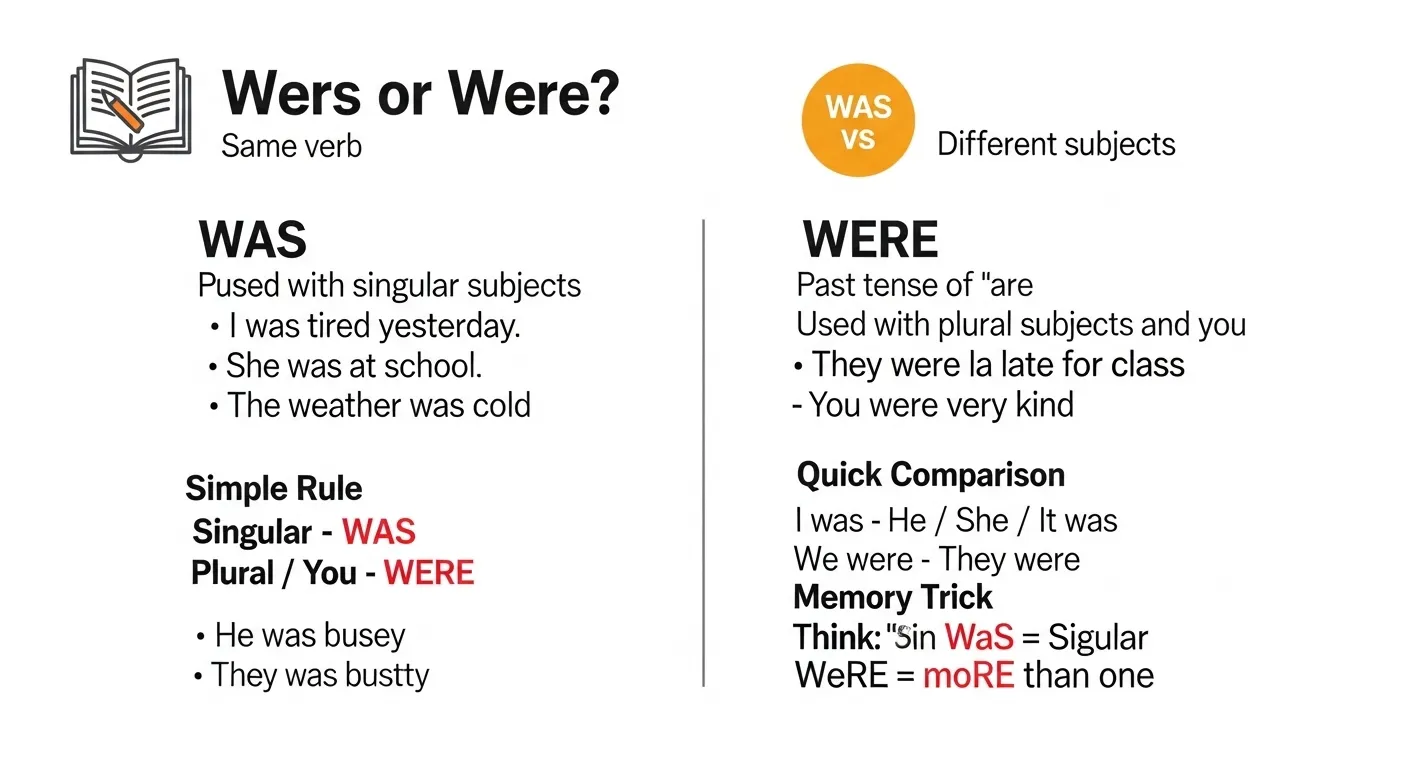
The difference between were and was is that “was” is used with singular subjects, while “were” is used with plural subjects and some imaginary situations.
Imagine a student telling a teacher, “Yesterday I were very tired.” The teacher kindly corrects the sentence: “Yesterday I was very tired.” This small correction shows why understanding the difference between were and was matters in everyday English.
Many learners make mistakes because both words come from the same verb “to be.” Learning the difference between were and was helps people write clearly and speak with confidence.
When students understand the difference between were and was, their grammar becomes stronger and their sentences become easier to understand.
🔑 Key Difference Between the Both
The basic difference depends on subject agreement.
- Was is used with singular subjects like I, he, she, it.
- Were is used with plural subjects like we, you, they.
Examples:
- I was happy yesterday.
- They were happy yesterday.
🌍 Why Is Their Difference Necessary to Know?
Understanding the difference between were and was is important for learners and language experts because grammar shapes how clearly people communicate. In schools, correct grammar helps students write stronger essays and understand books more easily.
In professional environments, correct language builds trust and confidence and daily conversations, using the right word makes sentences easier to understand. When people know when to use was and were, they avoid common mistakes and express ideas clearly. This knowledge strengthens communication skills and helps individuals present their thoughts more effectively in society.
🔊 Pronunciation (US & UK)
| Word | US Pronunciation | UK Pronunciation |
| Was | /wʌz/ | /wɒz/ |
| Were | /wɝː/ | /wɜː/ |
➡️ Now let us explore the detailed difference between these two words with clear explanations and examples.
📊 Difference Between Were and Was
1️⃣ Subject Agreement
Was is used with singular subjects, while were is used with plural subjects.
Examples:
- She was late for the meeting.
- The dog was sleeping.
Examples:
- They were late for the meeting.
- The students were studying.
2️⃣ Use with “I”
“I” usually takes was in past tense sentences.
Examples:
- I was tired after work.
- I was at home yesterday.
Examples with plural subject:
- We were tired after work.
- We were at home yesterday.
3️⃣ Imaginary or Unreal Situations
Were is often used when talking about imaginary situations.
Examples:
- If I were a bird, I would fly.
- If she were here, she would help.
Examples with real past using was:
- I was happy yesterday.
- She was at the party.
4️⃣ Sentence Tone
“Were” sometimes appears in more formal conditional sentences.
Examples:
- If he were the leader, things would change.
- If the plan were successful, profits would rise.
Examples with was:
- He was the leader last year.
- The plan was successful.
5️⃣ Plural Subjects
Plural nouns always use were.
Examples:
- The children were playing.
- The books were on the table.
Examples with singular noun using was:
- The child was playing.
- The book was on the table.
6️⃣ Questions in Past Tense
Both words appear in questions depending on the subject.
Examples with was:
- Was she happy?
- Was the meeting useful?
Examples with were:
- Were they ready?
- Were the lights on?
7️⃣ Negative Sentences
Both can form negative sentences with not.
Examples with was:
- She was not ready.
- The room was not clean.
Examples with were:
- They were not ready.
- The rooms were not clean.
8️⃣ Collective Nouns
Collective nouns sometimes use either word depending on meaning.
Examples with was:
- The team was winning.
- The family was happy.
Examples with were:
- The team were arguing among themselves.
- The family were discussing dinner.
9️⃣ Passive Voice
Both appear in passive sentences.
Examples with was:
- The letter was written yesterday.
- The cake was baked at home.
Examples with were:
- The letters were written yesterday.
- The cakes were baked at home.
🔟 Polite Conditional Expressions
“Were” may appear in polite formal expressions.
Examples:
- If I were to ask a question, would you answer?
- If she were to join us, it would help.
Examples with was:
- I was planning to ask a question.
- She was planning to join us.
🧠 Nature and Behaviour of Were and Was
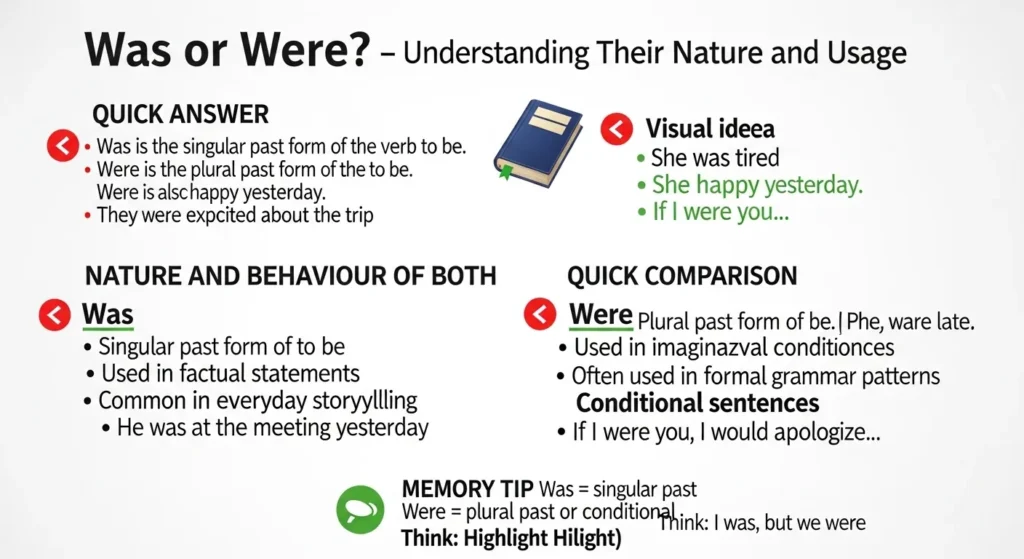
Was
- Singular past form of to be
- Used in factual statements
- Common in everyday storytelling
Were
- Plural past form of to be
- Used in imaginary or conditional sentences
- Often used in formal grammar patterns
❓ Why People Are Confused About Their Use
Many learners feel confused because both words come from the verb “to be.” They look similar and appear in past-tense sentences, which makes the choice difficult for beginners. Another reason is that “were” sometimes appears with the pronoun I in imaginary expressions like “If I were you.” This pattern feels unusual because “I” normally uses “was.” In addition, fast spoken English makes the two words sound alike, which adds more confusion for learners who are still building their grammar skills.
📋 Table: Difference and Similarity
| Feature | Was | Were |
| Verb Type | Past form of “to be” | Past form of “to be” |
| Subject | Singular | Plural |
| Example | She was happy | They were happy |
| Imaginary Situations | Rare | Common |
| Pronoun Example | I was | We were |
| Sentence Type | Statements | Statements & conditional sentences |
⚖️ Which Is Better in What Situation?
Was
“Was” works best when speaking about one person or thing in the past. It fits naturally with subjects like I, he, she, and it. Writers often use it to describe real past events. For example, “The meeting was very interesting.” In storytelling and daily conversation, “was” helps explain what happened earlier. Using it correctly keeps sentences clear and grammatically correct.
Were
“Were” is the correct choice when talking about more than one person or object in the past. For example, “They were excited about the trip.” It is also used in imaginary situations such as “If I were rich, I would travel the world.” This structure allows speakers to express ideas that are not real but possible in imagination.
🎭 Use in Metaphors and Similes
Metaphor example:
- He was a rock during difficult times.
Simile example:
- They were like stars shining in the night.
💬 Connotative Meaning
| Word | Connotation | Example |
| Was | Neutral | She was calm during the storm. |
| Were | Neutral | If I were brave, I would try it. |
Both words generally carry neutral meanings because they function mainly as grammatical tools.
🗣️ Idioms Related to Them
If I were you
Meaning: giving advice.
Example:
- If I were you, I would practice English every day.
As it were
Meaning: in a way or so to speak.
Example:
- He became the leader, as it were, of the group.
📚 Works in Literature Containing These Words
- “If I Were a Boy” – Song/Poetic lyrics, Beyoncé Knowles, 2008
- “The Day I Was Born” – Memoir, William Saroyan, 1971
- “I Was Told There’d Be Cake” – Essay Collection, Sloane Crosley, 2008
🎬 Movies Using the Words
- “If I Were King” – 1938, USA
- “I Was a Teenage Werewolf” – 1957, USA
- “If I Were You” – 2012, Canada
❔ Frequently Asked Questions
1. What is the main difference between was and were?
“Was” is used with singular subjects, while “were” is used with plural subjects.
2. Can “were” be used with “I”?
Yes. In imaginary expressions like “If I were you.”
3. Is “was” a past tense verb?
Yes. It is the past form of the verb “to be.”
4. Why do learners mix these words?
Because both come from the same verb and look very similar.
5. Are both important in English grammar?
Yes. They help describe past situations clearly.
🌱 How Both Are Useful for Surroundings
Both words help people explain past events clearly in daily communication, education, and writing. They allow speakers to describe what happened earlier and also imagine different possibilities. In classrooms, offices, and social conversations, correct usage helps listeners understand the message without confusion.
✍️ Final Words for Both
Was describes past actions related to a single subject.
Were describes past actions for plural subjects and imaginary situations.
Together, they play an important role in clear English communication.
🏁 Conclusion
Understanding the difference between were and was is essential for building strong English grammar skills. Both words belong to the past form of the verb “to be,” yet they serve different purposes depending on the subject and the type of sentence.
Was usually describes real past events connected to a single subject, while were is used with plural subjects and in imaginary expressions.
Learning these patterns helps students avoid common mistakes and create clearer sentences. With regular practice and careful attention to subject agreement, learners can confidently use both words in speaking and writing.
Discover More Articles:

I’m Owen Parker, and I write articles that focus on explaining the differences between common concepts, tools, and ideas. I enjoy simplifying complex information and turning it into clear comparisons that anyone can understand. My work often covers science , education, technology, and everyday knowledge topics.