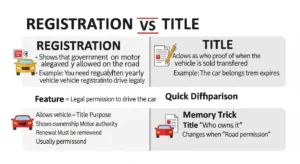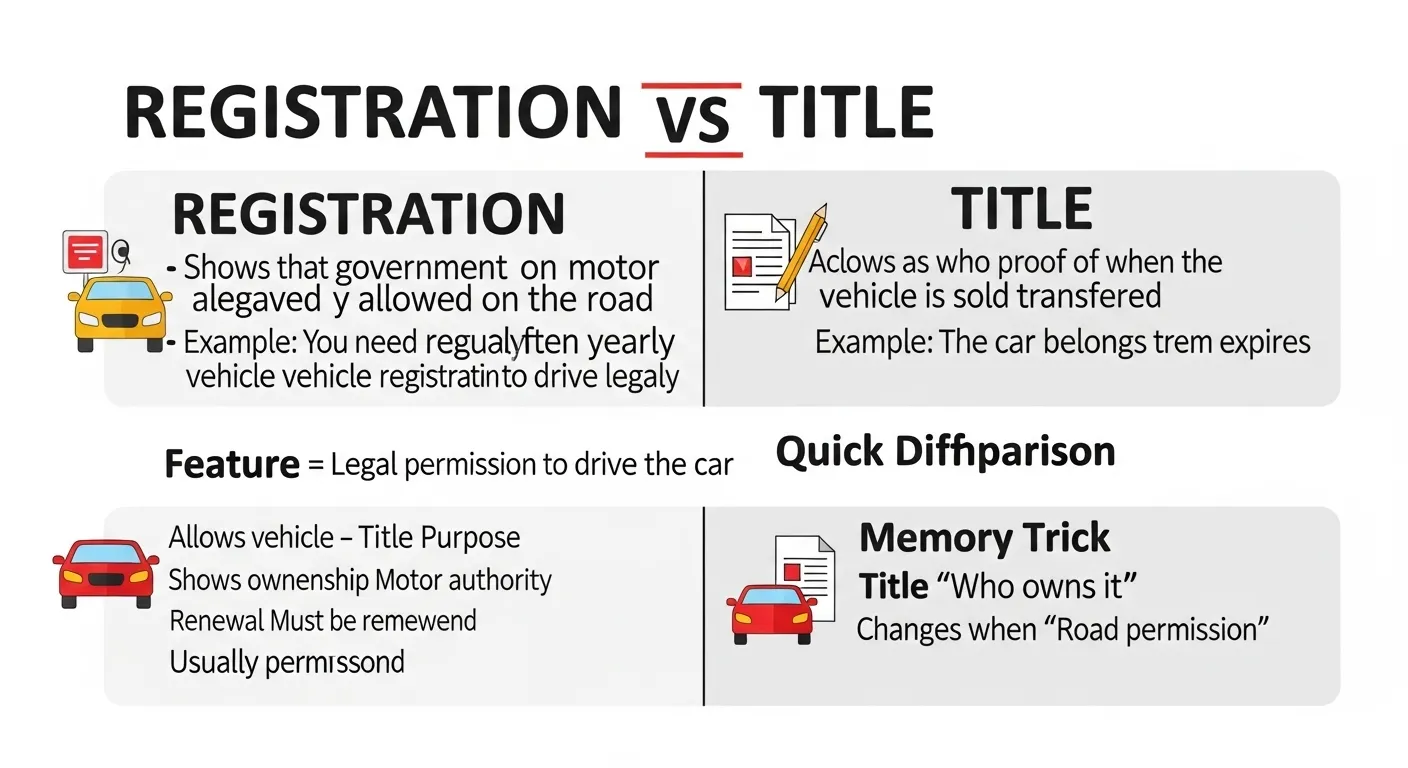
The difference between registration and title is that a title proves legal ownership of a vehicle, while registration shows that the vehicle is officially allowed to operate on public roads.
Imagine a person buying a car from a dealership. The buyer receives a title, which confirms that the vehicle legally belongs to them.
The owner visits a government office to complete the registration, allowing the car to be driven legally on the road. Understanding the difference between registration and title helps vehicle owners handle legal documents correctly.
Knowing the difference between registration and title also prevents confusion during buying, selling, or transferring vehicle ownership.
🔑 Key Difference Between the Both
The main difference lies in ownership versus legal road permission.
- Title: A legal document proving who owns the vehicle.
- Registration: A document showing the vehicle is authorized to be driven on public roads.
Examples:
- When someone buys a car, they receive the title as proof of ownership.
- During a vehicle sale, the title must be transferred to the new owner.
Examples:
- Drivers must renew registration periodically to keep their vehicles legal on roads.
- Police may ask for registration during traffic checks.
🌍 Why Is Their Difference Necessary to Know?
Understanding the difference between registration and title is important for vehicle owners and buyers. Many people assume both documents serve the same purpose, though they perform different legal roles. The title proves ownership of a vehicle, while registration confirms that the vehicle meets legal requirements for road use. During vehicle purchases, sales, or transfers, both documents become essential. Knowing the difference between registration and title helps individuals avoid legal problems and ensures that vehicle ownership and road permission remain properly documented.
🔊 Pronunciation (US & UK)
| Word | US Pronunciation | UK Pronunciation |
| Registration | /ˌredʒɪˈstreɪʃən/ | /ˌredʒɪˈstreɪʃən/ |
| Title | /ˈtaɪtəl/ | /ˈtaɪtəl/ |
➡️ Let us explore the detailed difference between registration and title through simple explanations and examples.
📑 Difference Between Registration and Title
1️⃣ Definition
A title proves legal ownership of a vehicle.
Registration confirms that the vehicle is permitted to operate on public roads.
Examples:
- A car buyer receives a title after purchasing the vehicle.
- The title lists the owner’s name.
Examples:
- The government issues registration after the vehicle is approved for road use.
- Drivers must carry registration while driving.
2️⃣ Purpose
The title focuses on ownership rights.
Registration focuses on legal road operation.
Examples:
- Selling a car requires transferring the title.
- The title identifies the legal owner.
Examples:
- Road authorities verify registration during inspections.
- Drivers renew registration regularly.
3️⃣ Issuing Authority
A title is issued by a government transport authority.
Registration is also issued by transport authorities for road use approval.
Examples:
- The transport department provides the vehicle title.
- Ownership changes require updating the title.
Examples:
- The same department issues registration certificates.
- Vehicles receive new registration numbers after approval.
4️⃣ Renewal Requirement
A title usually does not require regular renewal.
Registration must be renewed periodically.
Examples:
- The title remains valid unless ownership changes.
- Vehicle owners keep the title for many years.
Examples:
- Drivers renew registration annually or every few years.
- Expired registration can lead to penalties.
5️⃣ Information Included
The title includes details about ownership and vehicle identification.
Registration includes vehicle details and license plate information.
Examples:
- The title lists the owner’s name and vehicle identification number.
- Ownership transfer updates the title.
Examples:
- Registration records the license plate number.
- The document also shows renewal dates.
6️⃣ Importance During Sale
The title is required when selling a vehicle.
Registration may not always be required for ownership transfer.
Examples:
- The seller signs the title to transfer ownership.
- Buyers verify the title before purchase.
Examples:
- Buyers may check registration for road legality.
- The registration document confirms the vehicle is active.
7️⃣ Legal Role
The title serves as ownership evidence.
Registration serves as road-use authorization.
Examples:
- Courts may examine the title in ownership disputes.
- The title confirms legal possession.
Examples:
- Traffic authorities verify registration during stops.
- Vehicles without registration may face fines.
8️⃣ Physical Document
A title is often a certificate stored safely by the owner.
Registration may appear as a certificate or card.
Examples:
- Owners keep the title in a secure place.
- Banks may hold the title if a loan exists.
Examples:
- Drivers carry registration in the vehicle.
- Authorities may request registration documents.
9️⃣ Timing of Issue
A title is issued when a vehicle is purchased or ownership changes.
Registration is issued after the vehicle is approved for road use.
Examples:
- New buyers receive the title during ownership transfer.
- The title reflects the new owner’s details.
Examples:
- The vehicle receives registration after inspection.
- Road authorities approve registration.
🔟 Legal Importance
The title establishes property rights.
Registration confirms compliance with road regulations.
Examples:
- The title protects ownership claims.
- Insurance companies may verify the title.
Examples:
- Police may request registration during traffic checks.
- Road use without registration may lead to fines.
🧠 Nature and Behaviour of registration and title
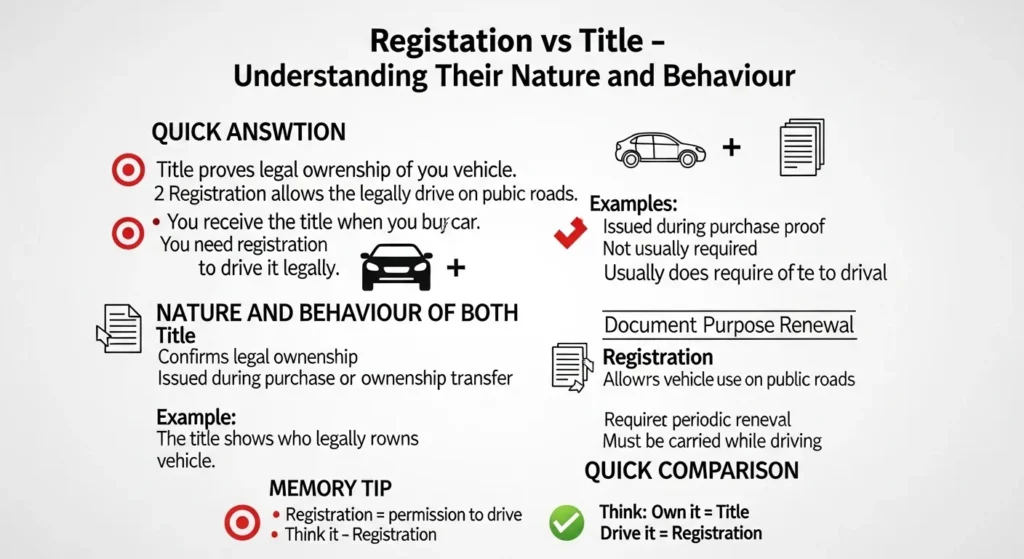
Title
- Confirms legal ownership
- Issued during purchase or ownership transfer
- Usually does not require renewal
Registration
- Allows vehicle use on public roads
- Requires periodic renewal
- Must be carried while driving
❓ Why People Are Confused About Their Use
People often confuse registration and title because both documents relate to the same vehicle and are issued by government authorities. Many vehicle owners receive these documents around the same time during purchase or registration procedures. Since both include vehicle information, individuals may assume they serve identical purposes. The confusion becomes clearer when people understand that the title represents ownership, while registration represents road authorization.
📋 Table: Difference and Similarity
| Feature | Title | Registration |
| Main Purpose | Proof of ownership | Permission to drive |
| Renewal | Usually not required | Required periodically |
| Role in Sale | Ownership transfer | Not always required |
| Information | Owner and vehicle ID | License plate and validity |
| Legal Focus | Property rights | Road compliance |
⚖️ Which Is Better in What Situation?
Title
A title becomes important during buying, selling, or transferring ownership of a vehicle. It proves who legally owns the car and protects property rights. Without a title, ownership claims can become difficult to verify.
Registration
Registration becomes important when operating a vehicle on public roads. It confirms that the vehicle meets legal requirements such as inspection and taxation. Drivers must maintain valid registration to avoid penalties and drive legally.
🎭 Use in Metaphors and Similes
Metaphor example:
- His achievement became the title of his life story.
Simile example:
- Her dedication stood like a registration marking her place in the team.
💬 Connotative Meaning
| Word | Connotation | Example |
| Title | Ownership, recognition | She earned the title of champion. |
| Registration | Official approval | His entry required official registration. |
🗣️ Idioms or Expressions
Claim the title
Meaning: achieve recognition or victory.
Example:
- The athlete worked hard to claim the title in the competition.
📚 Works in Literature Using the Word Title
- “Pride and Prejudice” – Jane Austen, 1813
- “Great Expectations” – Charles Dickens, 1861
🎬 Movies Using the Word Title
- “The Title” – 2020, USA
- “The Champion Title” – 2019, UK
❔ Frequently Asked Questions
1. What is the main difference between registration and title?
A title proves vehicle ownership, while registration allows the vehicle to be legally driven on roads.
2. Do all vehicles have both documents?
Yes, most vehicles require both ownership and road authorization documents.
3. Does a title expire?
A title usually remains valid until ownership changes.
4. Does registration expire?
Yes, registration usually requires periodic renewal.
5. Can you sell a car without a title?
Selling a vehicle without a title can create legal complications because ownership cannot be verified.
🌍 How Both Are Useful for Surroundings
Registration and title systems help maintain legal order in transportation. They allow authorities to track vehicle ownership, enforce road regulations, and ensure accountability among drivers. These documents support organized transportation systems and protect vehicle owners’ legal rights.
✍️ Final Words for Both
Title represents legal ownership of a vehicle.
Registration represents legal permission to operate that vehicle on public roads.
Both documents work together to maintain lawful vehicle management.
🏁 Conclusion
Understanding the difference between registration and title helps vehicle owners manage important documents correctly. A title proves ownership and protects property rights, while registration confirms that a vehicle is legally approved for road use.
Although both documents contain vehicle information and are issued by government authorities, they serve different purposes.
Recognizing these differences allows individuals to handle vehicle purchases, sales, and legal requirements with greater confidence and clarity.
Discover More Articles:

I’m Owen Parker, and I write articles that focus on explaining the differences between common concepts, tools, and ideas. I enjoy simplifying complex information and turning it into clear comparisons that anyone can understand. My work often covers science , education, technology, and everyday knowledge topics.