The difference between PERT and CPM is that PERT is used for uncertain project timelines, while CPM is used for fixed and predictable schedules.
Imagine managing two projects one where task durations are unknown, like research work, and another where tasks are well-defined, like construction. In such cases, PERT helps estimate time with flexibility, while CPM focuses on planning exact timelines.
Understanding the difference between PERT and CPM helps in better project planning and execution.
Knowing the difference between PERT and CPM also improves time management, resource allocation, and decision-making in professional environments.
🔑 Key Difference Between the Both
The main difference lies in time estimation and approach.
- PERT: Uses probabilistic time estimates.
- CPM: Uses fixed time estimates.
Examples:
- PERT handles uncertainty.
- It is flexible.
Examples:
- CPM follows a fixed schedule.
- It is structured.
🌍 Why Is Their Difference Necessary to Know?
Understanding the difference between PERT and CPM is important in project management. Different projects require different planning methods, and using the wrong technique can lead to delays or inefficiencies. Knowing the difference between PERT and CPM helps managers choose the right approach based on project complexity and uncertainty. It also improves productivity, reduces risks, and ensures better use of resources in organizations and industries.
🔊 Pronunciation (US & UK)
| Term | US Pronunciation | UK Pronunciation |
| PERT | /pɜːrt/ | /pɜːt/ |
| CPM | /ˌsiː piː ˈɛm/ | /ˌsiː piː ˈɛm/ |
➡️ Now let us explore the detailed difference between PERT and CPM step by step.
📊 Difference Between PERT and CPM
1️⃣ Full Form
PERT stands for Program Evaluation and Review Technique.
CPM stands for Critical Path Method.
Examples:
- PERT focuses on evaluation.
- It reviews tasks.
Examples:
- CPM identifies critical path.
- It controls time.
2️⃣ Nature
PERT is probabilistic.
CPM is deterministic.
Examples:
- PERT deals with uncertainty.
- It uses estimates.
Examples:
- CPM uses fixed data.
- It is certain.
3️⃣ Time Estimation
PERT uses three time estimates.
CPM uses one time estimate.
Examples:
- PERT uses optimistic, pessimistic, and most likely times.
- It is flexible.
Examples:
- CPM uses a single value.
- It is precise.
4️⃣ Focus
PERT focuses on time.
CPM focuses on time and cost.
Examples:
- PERT manages deadlines.
- It is time-oriented.
Examples:
- CPM balances cost and time.
- It is efficient.
5️⃣ Usage
PERT is used in research projects.
CPM is used in construction projects.
Examples:
- PERT fits uncertain work.
- It is adaptable.
Examples:
- CPM fits predictable work.
- It is structured.
6️⃣ Complexity
PERT is more complex.
CPM is simpler.
Examples:
- PERT requires calculations.
- It is detailed.
Examples:
- CPM is straightforward.
- It is easy.
7️⃣ Orientation
PERT is event-oriented.
CPM is activity-oriented.
Examples:
- PERT focuses on milestones.
- It tracks events.
Examples:
- CPM focuses on tasks.
- It tracks activities.
8️⃣ Risk Handling
PERT handles risk better.
CPM handles risk less.
Examples:
- PERT accounts for uncertainty.
- It reduces risk.
Examples:
- CPM assumes certainty.
- It has less flexibility.
9️⃣ Application
PERT is used in new projects.
CPM is used in repetitive projects.
Examples:
- PERT suits innovation.
- It is dynamic.
Examples:
- CPM suits routine work.
- It is stable.
🔟 Flexibility
PERT is flexible.
CPM is less flexible.
Examples:
- PERT adjusts easily.
- It adapts.
Examples:
- CPM follows fixed plans.
- It is rigid.
🧠 Nature and Behaviour of Pert and Cpm
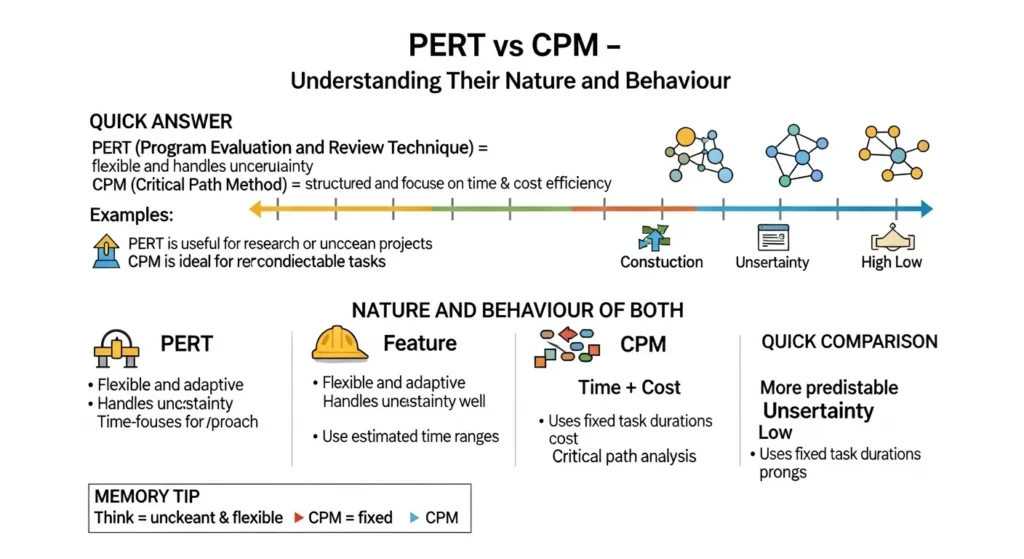
PERT
- Flexible and adaptive
- Handles uncertainty
- Time-focused
CPM
- Structured and fixed
- Predictable outcomes
- Time and cost-focused
❓ Why People Are Confused About Their Use
People often confuse PERT and CPM because both are project management techniques used to plan and schedule tasks. They share similarities in structure and purpose. The confusion becomes clear when understanding that PERT is flexible and uncertain, while CPM is fixed and predictable.
📋 Table: Difference and Similarity
| Feature | PERT | CPM |
| Nature | Probabilistic | Deterministic |
| Time | Multiple estimates | Single estimate |
| Focus | Time | Time & cost |
| Use | Uncertain projects | Predictable projects |
| Flexibility | High | Low |
⚖️ Which Is Better in What Situation?
PERT
PERT is better for projects with uncertainty, such as research, development, and innovation. It helps manage unpredictable timelines and risks.
CPM
CPM is better for projects with fixed schedules, such as construction and manufacturing. It ensures efficiency and cost control.
🎭 Use in Metaphors and Similes
Metaphor example:
- PERT is like exploring unknown paths.
Simile example:
- CPM is like a straight road with clear directions.
💬 Connotative Meaning
| Term | Connotation | Example |
| PERT | Flexibility, uncertainty | The plan felt like PERT. |
| CPM | Structure, control | The system worked like CPM. |
🗣️ Expressions
Examples:
- Plan like PERT
- Execute like CPM
📚 Works in Literature
- “Project Management: A Systems Approach” – Harold Kerzner, 2017
- “Operations Management” – William J. Stevenson, 2018
🎬 Movies Related to Planning and Strategy
- “Moneyball” – 2011, USA
- “The Founder” – 2016, USA
❔ Frequently Asked Questions
1. What is the main difference between PERT and CPM?
PERT uses multiple time estimates, while CPM uses a single estimate.
2. Which is more flexible?
PERT is more flexible.
3. Which focuses on cost?
CPM focuses on cost and time.
4. Where is PERT used?
In uncertain projects like research.
5. Where is CPM used?
In predictable projects like construction.
🌍 How Both Are Useful for Surroundings
PERT and CPM help organizations plan projects efficiently, reduce delays, and improve productivity. They are essential tools in modern project management.
✍️ Final Words for Both
PERT represents flexibility and uncertainty.
CPM represents structure and control.
Both are valuable tools for project success.
🏁 Conclusion
Understanding the difference between PERT and CPM helps in choosing the right project management method. PERT is suitable for uncertain and flexible projects, while CPM is ideal for structured and predictable tasks.
Although both aim to improve efficiency, their approaches are different. Learning this difference ensures better planning, execution, and successful project outcomes.
Discover More Articles:

I’m Owen Parker, and I write articles that focus on explaining the differences between common concepts, tools, and ideas. I enjoy simplifying complex information and turning it into clear comparisons that anyone can understand. My work often covers science , education, technology, and everyday knowledge topics.