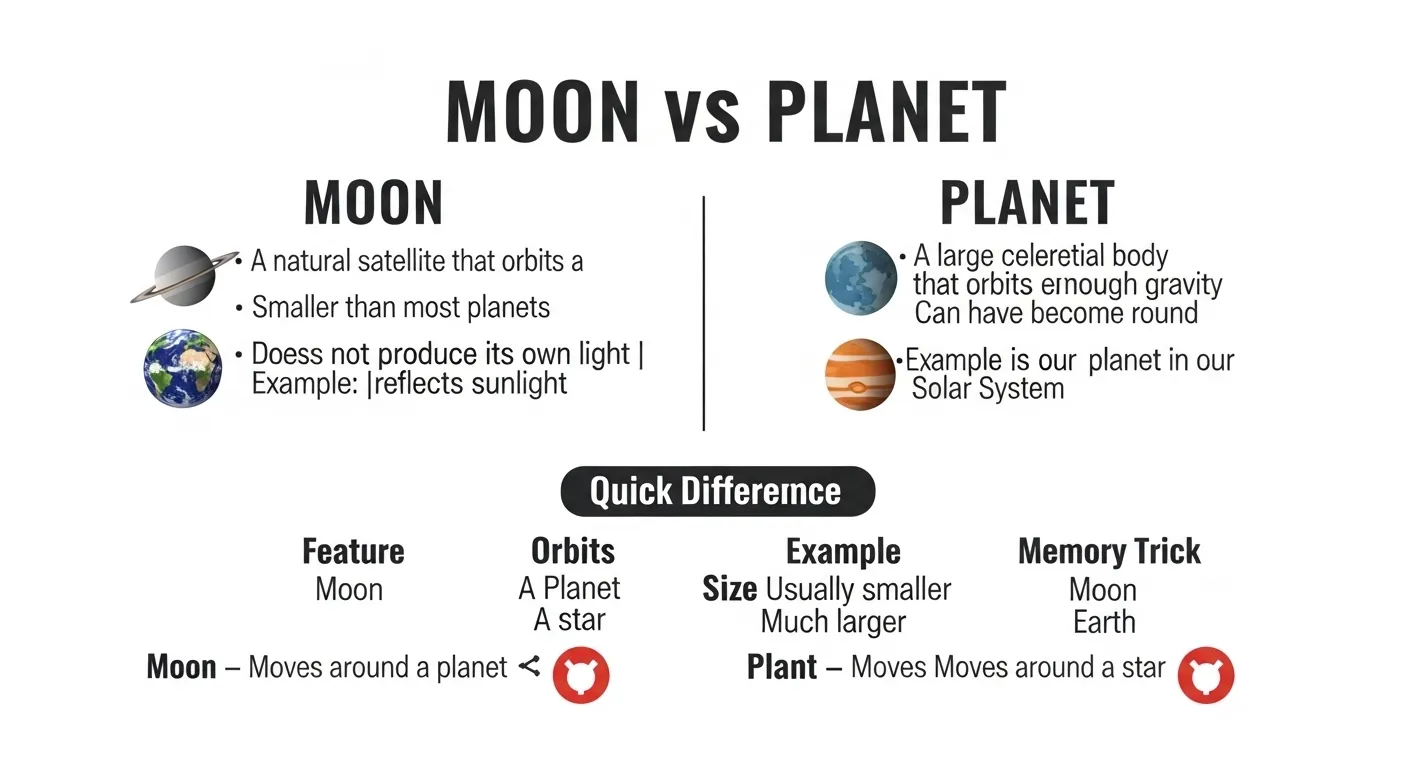
The difference between moon and planet is that a planet moves around a star, while a moon moves around a planet.
Imagine looking at the night sky with a telescope. You may notice large glowing objects such as Mars or Jupiter moving across the sky over time. These are planets because they orbit the Sun. Near some of these planets, smaller bodies travel along with them.
These smaller objects are moons that circle planets. Understanding the difference between moon and planet helps people explain how objects move in space and how planetary systems are organized.
Learning the difference between moon and planet also helps students and space enthusiasts understand the structure of our solar system.
🔑 Key Difference Between the Both
The main difference lies in what each object orbits in space.
- Planet: A large celestial body that moves around a star.
- Moon: A natural satellite that moves around a planet.
Examples:
- Earth is a planet because it orbits the Sun.
- The Moon is Earth’s natural satellite.
🌍 Why Is Their Difference Necessary to Know?
Understanding the difference between moon and planet is important for learning about space and the structure of the universe. Astronomers classify celestial bodies based on their motion and physical characteristics. Planets play a central role in solar systems because they orbit stars and may have moons around them. Moons can influence planetary environments, tides, and even climate conditions on certain worlds. For students and researchers, recognizing this difference helps explain how planetary systems develop and how objects interact in space. This knowledge also inspires curiosity about astronomy and encourages exploration of the universe.
🔊 Pronunciation (US & UK)
| Word | US Pronunciation | UK Pronunciation |
| Moon | /muːn/ | /muːn/ |
| Planet | /ˈplænɪt/ | /ˈplænɪt/ |
➡️ Let us explore the detailed difference between moon and planet with simple explanations and examples.
🪐 Difference Between Moon and Planet
1️⃣ Definition
A planet is a large body that orbits a star.
A moon is a natural satellite that orbits a planet.
Examples:
- Earth is a planet that moves around the Sun.
- Mars is another planet in the solar system.
Examples:
- The Moon orbits Earth.
- Europa is a moon of Jupiter.
2️⃣ Orbit Path
A planet travels around a star.
A moon travels around a planet.
Examples:
- Venus moves around the Sun.
- Saturn follows an orbit around the Sun.
Examples:
- Titan orbits Saturn.
- Phobos orbits Mars.
3️⃣ Size
Planets are usually larger.
Moons are generally smaller.
Examples:
- Jupiter is the largest planet in the solar system.
- Earth is larger than its moon.
Examples:
- Deimos is a small moon of Mars.
- Many moons are much smaller than planets.
4️⃣ Role in the Solar System
Planets form the main structure of solar systems.
Moons support and orbit planets.
Examples:
- The solar system contains several planets.
- Planets may host moons and rings.
Examples:
- Jupiter has many moons.
- Saturn’s moons orbit around it.
5️⃣ Formation
Planets usually form from large disks of dust and gas around stars.
Moons often form from leftover material around planets.
Examples:
- Earth formed billions of years ago from cosmic material.
- Neptune formed from gas and dust.
Examples:
- Earth’s Moon formed from debris after a massive collision.
- Some moons formed near their planets.
6️⃣ Gravity
Planets have strong gravitational pull.
Moons have weaker gravity compared to planets.
Examples:
- Jupiter’s gravity influences many objects.
- Earth’s gravity keeps the Moon in orbit.
Examples:
- The Moon has weaker gravity than Earth.
- Astronauts can jump higher on the Moon.
7️⃣ Number in the Solar System
There are fewer planets compared to moons.
Moons are far more numerous.
Examples:
- The solar system has eight planets.
- Each planet has a unique orbit.
Examples:
- Jupiter alone has dozens of moons.
- Saturn also has many moons.
8️⃣ Atmosphere
Some planets have thick atmospheres.
Many moons have little or no atmosphere.
Examples:
- Venus has a dense atmosphere.
- Earth has an atmosphere supporting life.
Examples:
- The Moon has almost no atmosphere.
- Many moons exist in vacuum conditions.
9️⃣ Ability to Have Moons
Planets can have moons.
Moons usually do not have their own moons.
Examples:
- Earth has one moon.
- Jupiter has many moons.
Examples:
- Most moons orbit only their planet.
- A moon rarely has a smaller satellite.
🔟 Movement in Space
Planets travel around stars along large paths.
Moons move along smaller paths around planets.
Examples:
- Mercury completes an orbit around the Sun.
- Earth completes one orbit in a year.
Examples:
- The Moon circles Earth every month.
- Other moons follow their planets through space.
🧠 Nature and Behaviour of moon and planet
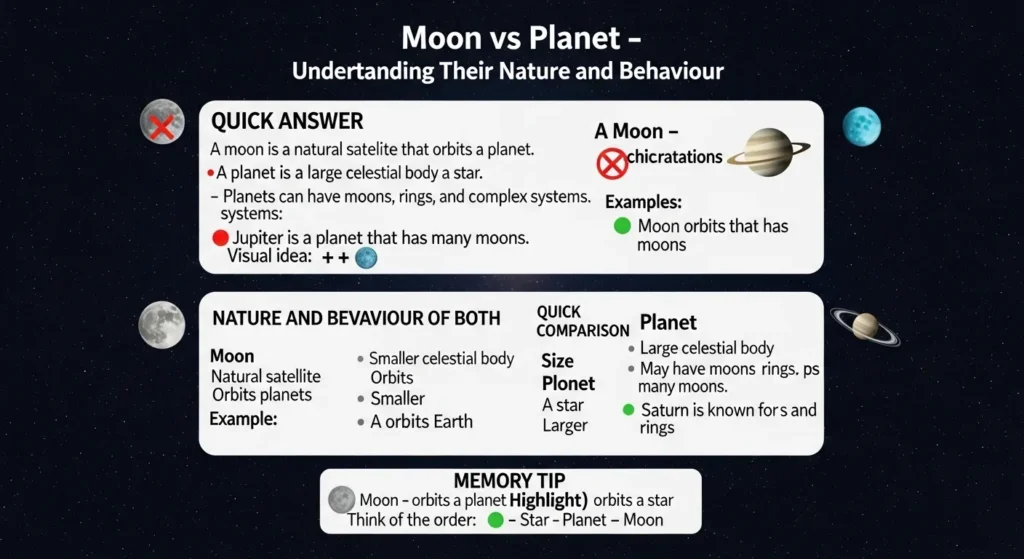
Moon
- Natural satellite
- Smaller celestial body
- Orbits planets
Planet
- Large celestial body
- Orbits a star
- May have moons and rings
❓ Why People Are Confused About Their Use
Many people confuse moon and planet because both appear as bright objects in the night sky. Without scientific knowledge, it may be difficult to recognize their different roles in space. Some moons are very large and can look similar to small planets through telescopes. In addition, both objects move through space and reflect sunlight, which can make them seem alike. Learning about their orbits and positions in the solar system helps clarify their differences.
📋 Table: Difference and Similarity
| Feature | Moon | Planet |
| Orbit | Orbits a planet | Orbits a star |
| Size | Usually smaller | Usually larger |
| Role | Natural satellite | Major body of solar system |
| Gravity | Weaker | Stronger |
| Moons | Rarely has moons | Can have many moons |
⚖️ Which Is Better in What Situation?
Moon
A moon plays an important role in supporting its planet. For example, Earth’s Moon influences ocean tides and helps stabilize the planet’s rotation. In many planetary systems, moons also affect the gravitational balance of nearby objects. Their presence can shape planetary environments and contribute to natural cycles that influence life and planetary stability.
Planet
A planet serves as the central body in its orbital path around a star. Some planets may contain atmospheres, surfaces, and environments where life could exist. Planets also act as gravitational centers for their moons and nearby objects. Their large size and stable orbits make them key parts of planetary systems.
🎭 Use in Metaphors and Similes
Metaphor example:
- She was the moon of the group, quietly reflecting the light of others.
Simile example:
- The leader stood among the team like a planet surrounded by satellites.
💬 Connotative Meaning
| Word | Connotation | Example |
| Moon | Calm, mystery, beauty | The night felt peaceful under the moon. |
| Planet | Power, scale, importance | The project became a planet in his career universe. |
🗣️ Idioms or Expressions
Once in a blue moon
Meaning: something that happens very rarely.
Example:
- She visits that place once in a blue moon.
Promise the moon
Meaning: promise something impossible.
Example:
- The politician tried to promise the moon to voters.
📚 Works in Literature Using These Words
- “The First Men in the Moon” – Science Fiction Novel, H. G. Wells, 1901
- “The Moon Is a Harsh Mistress” – Science Fiction Novel, Robert A. Heinlein, 1966
- “The Little Prince” – Novella, Antoine de Saint-Exupéry, 1943 (planet theme)
🎬 Movies Using These Words
- “Moon” – 2009, United Kingdom
- “The Wandering Earth” – 2019, China (planetary theme)
- “Apollo 13” – 1995, USA (moon exploration)
❔ Frequently Asked Questions
1. What is the main difference between moon and planet?
A planet orbits a star, while a moon orbits a planet.
2. Can a planet have many moons?
Yes, some planets such as Jupiter have dozens of moons.
3. Does every planet have a moon?
No, some planets do not have natural satellites.
4. Is Earth’s Moon a planet?
No, it is a natural satellite of Earth.
5. Why do moons shine at night?
They reflect light from the Sun.
🌌 How Both Are Useful for Surroundings
Moons and planets play important roles in the structure of the universe. Planets form stable systems around stars, while moons help influence planetary environments through gravity. These interactions shape tides, orbital patterns, and many natural processes in space.
✍️ Final Words for Both
Moon represents a natural satellite that circles planets and reflects light.
Planet represents a large celestial body that orbits a star and may host moons.
Both objects help scientists understand how space systems work.
🏁 Conclusion
Understanding the difference between moon and planet allows people to better appreciate the structure of the solar system and the relationships between celestial bodies. A planet is a large object that travels around a star, while a moon is a natural satellite that travels around a planet. Both play important roles in shaping the movement and balance of objects in space.
By learning how they differ in size, orbit, and function, students and space enthusiasts can gain a clearer picture of how planetary systems operate. This knowledge encourages curiosity about astronomy and helps explain many natural phenomena observed in the night sky.

Hi, I’m Nabeel Hassan. I love exploring interesting topics and explaining how different things compare with each other. Through my writing, I aim to provide clear, helpful, and easy to read explanations. I cover subjects related to learning, science, technology and general knowledge.