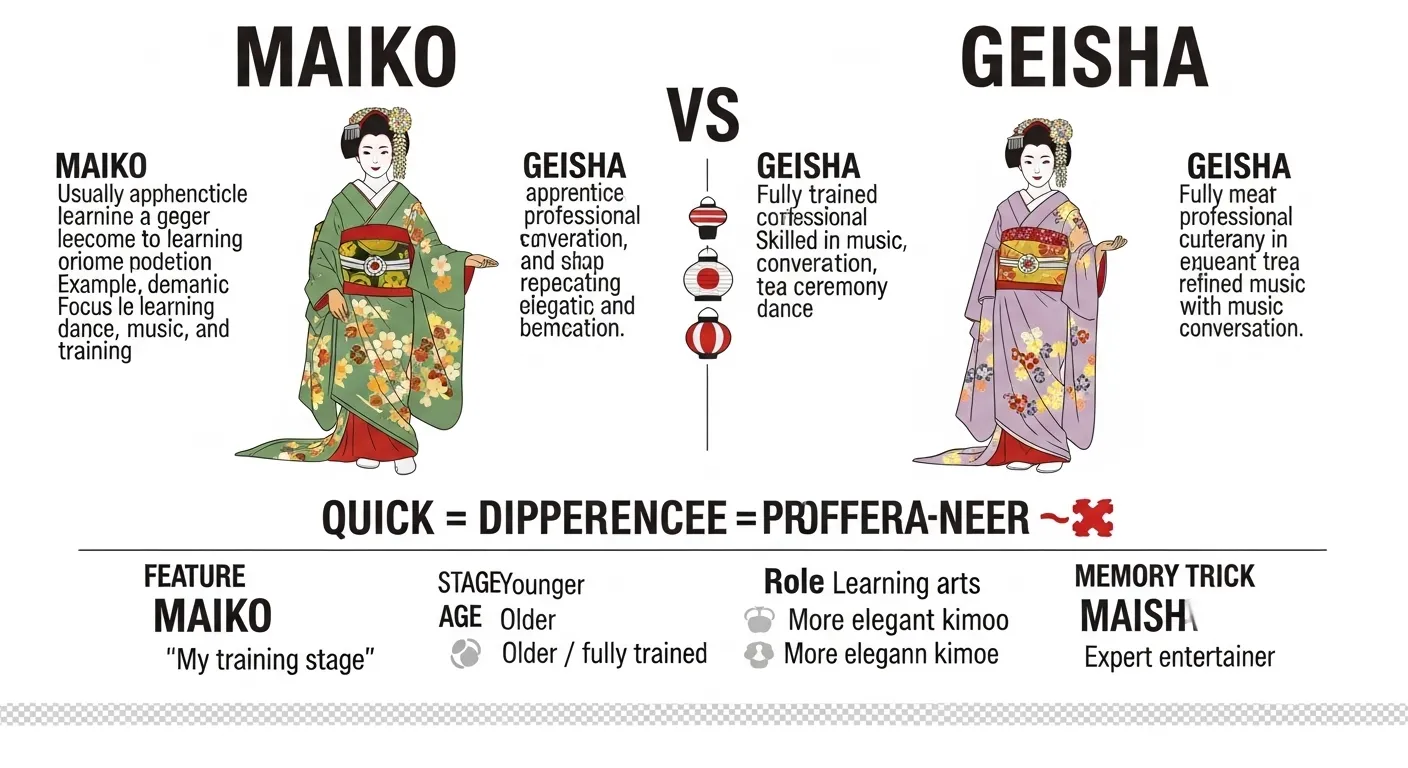
The difference between maiko and geisha is that a maiko is an apprentice entertainer in training, while a geisha is a fully trained professional performer.
Imagine visiting a traditional district in Kyoto where elegant entertainers walk along lantern-lit streets. Some wear very colorful kimono with elaborate hairstyles and ornaments. These are maiko, young trainees learning the arts of music, dance, and conversation. Others wear more refined clothing and move with calm confidence. These are geisha, experienced performers who have completed years of training.
Understanding the difference between maiko and geisha helps people appreciate the traditions and cultural roles these performers hold in Japanese society.
🔑 Key Difference Between the Both
The main difference lies in experience and training level.
- Maiko: A trainee learning traditional performing arts.
- Geisha: A fully trained professional entertainer.
Examples:
- A young performer learning dance and music may be a maiko.
- A skilled performer entertaining guests at formal gatherings is a geisha.
🌏 Why Is Their Difference Necessary to Know?
Understanding the difference between maiko and geisha helps people appreciate Japanese cultural traditions more accurately. Many visitors see both performers in historical districts and assume they are the same. In reality, the training process is long and structured. A maiko spends several years learning traditional arts such as dance, music, and polite conversation. After completing this training, she becomes a geisha. Knowing the difference between maiko and geisha allows people to respect their cultural roles and understand the dedication involved in mastering these traditional performances.
🔊 Pronunciation (US & UK)
| Word | US Pronunciation | UK Pronunciation |
| Maiko | /ˈmaɪkoʊ/ | /ˈmaɪkəʊ/ |
| Geisha | /ˈɡeɪʃə/ | /ˈɡeɪʃə/ |
➡️ Let us explore the detailed difference between maiko and geisha through clear explanations and examples.
🎭 Difference Between Maiko and Geisha
1️⃣ Meaning
A maiko is an apprentice entertainer learning traditional arts.
A geisha is a professional entertainer trained in those arts.
Examples:
- A teenager beginning traditional training becomes a maiko.
- A young apprentice performing in festivals may be a maiko.
Examples:
- An experienced performer hosting cultural events is a geisha.
- A professional artist entertaining guests at banquets is a geisha.
2️⃣ Training Level
A maiko is still in training.
A geisha has completed training.
Examples:
- A maiko studies dance and music daily.
- A maiko practices conversation and etiquette.
Examples:
- A geisha performs confidently at formal gatherings.
- A geisha demonstrates refined artistic skills.
3️⃣ Age
A maiko is usually younger.
A geisha is generally older and more experienced.
Examples:
- A young apprentice in her late teens may be a maiko.
- Many trainees begin their career as maiko.
Examples:
- A mature performer with years of training becomes a geisha.
- Experienced entertainers are known as geisha.
4️⃣ Clothing Style
A maiko wears very colorful and elaborate kimono.
A geisha wears more subtle and elegant kimono.
Examples:
- Bright kimono with long sleeves are common for maiko.
- Decorative hair ornaments often appear in maiko attire.
Examples:
- A geisha usually wears a simpler kimono design.
- Their clothing style appears refined and balanced.
5️⃣ Hairstyle
A maiko often uses natural hairstyles with ornaments.
A geisha commonly uses a wig styled professionally.
Examples:
- A maiko hairstyle includes detailed decorations.
- Flower ornaments may appear in maiko hair.
Examples:
- A geisha hairstyle looks smoother and simpler.
- Many geisha use wigs for convenience.
6️⃣ Makeup
A maiko typically uses brighter makeup.
A geisha uses more subtle makeup.
Examples:
- A maiko may paint her lips in bright colors.
- White face makeup is common for maiko performances.
Examples:
- A geisha makeup style appears more refined.
- The design may be simpler.
7️⃣ Performance Experience
A maiko is still developing performance skills.
A geisha performs with advanced mastery.
Examples:
- A maiko practices traditional dance routines.
- She may perform during cultural events.
Examples:
- A geisha leads entertainment at formal gatherings.
- She demonstrates polished artistic ability.
8️⃣ Responsibilities
A maiko spends more time learning and practicing.
A geisha spends more time performing professionally.
Examples:
- A maiko attends lessons daily.
- A maiko learns musical instruments.
Examples:
- A geisha entertains guests with music and conversation.
- She hosts cultural events.
9️⃣ Career Stage
A maiko represents the early stage of the profession.
A geisha represents the advanced stage.
Examples:
- Training years define the life of a maiko.
- Many apprentices work toward becoming geisha.
Examples:
- A geisha continues the tradition professionally.
- Her career may last many years.
🔟 Role in Culture
A maiko represents youth and learning within the tradition.
A geisha represents mastery of cultural arts.
Examples:
- Visitors often admire the vibrant style of maiko.
- Cultural districts may feature maiko performances.
Examples:
- A geisha represents refined Japanese performing arts.
- Her experience reflects years of dedication.
🧠 Nature and Behaviour of Maiko and Geisha
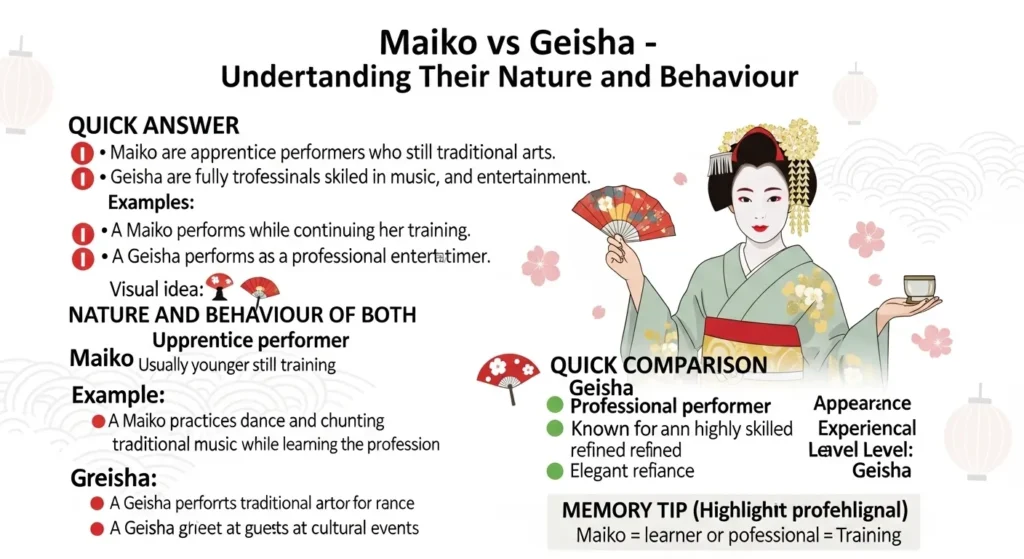
Maiko
- Apprentice performer
- Younger and still training
- Colorful clothing and elaborate style
Geisha
- Professional performer
- Experienced and skilled
- Elegant and refined appearance
❓ Why People Are Confused About Their Use
Many people confuse maiko and geisha because both wear traditional clothing and perform similar cultural arts. Visitors who see them walking through historical districts may not notice the subtle differences in clothing, hairstyle, or behavior. Since both roles belong to the same cultural profession, the distinction between trainee and professional can easily be misunderstood. Learning about their training stages and artistic roles helps clarify their identities.
📋 Table: Difference and Similarity
| Feature | Maiko | Geisha |
| Meaning | Apprentice entertainer | Professional entertainer |
| Experience | In training | Fully trained |
| Age | Usually younger | Usually older |
| Clothing | Bright and elaborate | Elegant and simple |
| Role | Learning stage | Professional stage |
⚖️ Which Is Better in What Situation?
Maiko
A maiko represents the learning stage of traditional performing arts. Her role focuses on training and developing artistic abilities. Cultural festivals and public events often feature maiko performances because their colorful appearance and youthful energy attract attention and celebrate the early stages of the tradition.
Geisha
A geisha represents the highest level of skill in traditional Japanese entertainment. She performs at formal gatherings and cultural events where refined performance and conversation are valued. Years of experience allow a geisha to present music, dance, and hospitality with confidence and grace.
🎭 Use in Metaphors and Similes
Metaphor example:
- The young artist was a maiko, learning every step of the craft.
Simile example:
- The experienced teacher moved like a geisha, calm and graceful.
💬 Connotative Meaning
| Word | Connotation | Example |
| Maiko | Youth, learning | The apprentice artist felt like a maiko beginning her journey. |
| Geisha | Elegance, mastery | Her performance carried the grace of a geisha. |
🗣️ Expressions Related to the Words
Examples:
- She trained like a maiko before mastering the art.
- His performance had the elegance of a geisha.
📚 Works in Literature About Geisha Culture
- “Memoirs of a Geisha” – Arthur Golden, 1997
- “Geisha: A Life” – Mineko Iwasaki, 2002
- “The Tale of Genji” – Murasaki Shikibu, 11th century
🎬 Movies About Geisha Culture
- “Memoirs of a Geisha” – 2005, USA
- “The Geisha” – 1983, Japan
- “Sakuran” – 2006, Japan
❔ Frequently Asked Questions
1. What is the main difference between maiko and geisha?
A maiko is an apprentice entertainer, while a geisha is a fully trained professional.
2. Do maiko become geisha?
Yes, after years of training, a maiko may become a geisha.
3. Where are maiko commonly seen?
They are often seen in traditional districts of Kyoto.
4. Do both perform traditional arts?
Yes, both perform music, dance, and conversation.
5. Why are maiko more colorful?
Their vibrant clothing highlights their role as apprentices.
🌸 How Both Are Useful for Surroundings
Maiko and geisha preserve traditional Japanese performing arts and cultural heritage. Their performances keep classical music, dance, and hospitality traditions alive. Cultural districts, festivals, and historical communities benefit from their presence because they represent centuries of artistic practice.
✍️ Final Words for Both
Maiko represents the learning stage of a traditional entertainer.
Geisha represents mastery and professional artistry in cultural performance.
Both play important roles in preserving traditional arts.
🏁 Conclusion
Understanding the difference between maiko and geisha allows people to appreciate Japanese cultural traditions more deeply. A maiko represents the apprentice stage where young performers learn dance, music, and etiquette.
A geisha represents the professional stage achieved after years of training and dedication. Although their appearances and roles may seem similar at first, their level of experience and responsibilities differ significantly.
By recognizing these differences, visitors and students of culture can better understand the dedication behind these traditional performers and the rich heritage they continue to preserve.
Discover More Articles:

I’m Owen Parker, and I write articles that focus on explaining the differences between common concepts, tools, and ideas. I enjoy simplifying complex information and turning it into clear comparisons that anyone can understand. My work often covers science , education, technology, and everyday knowledge topics.