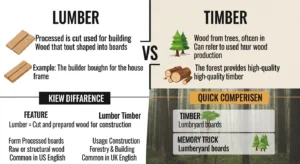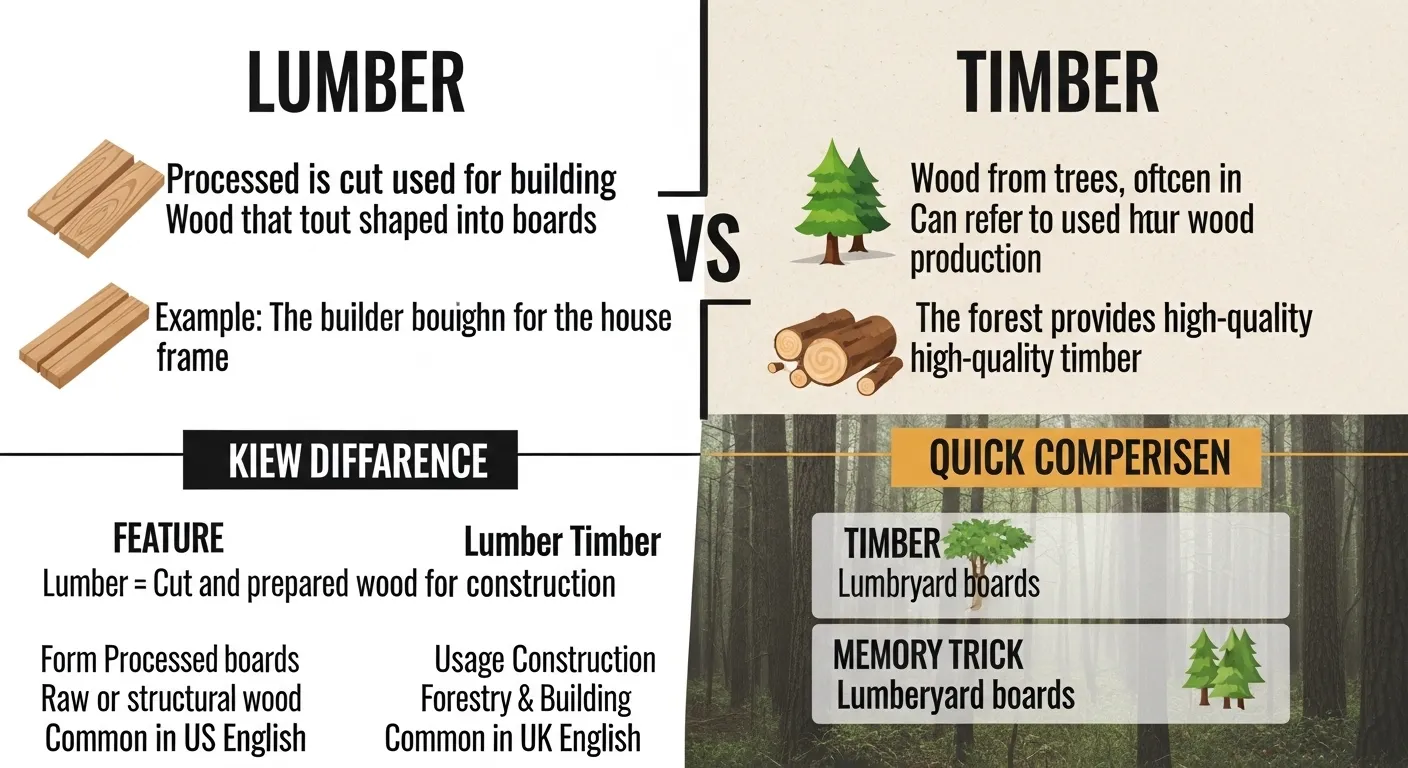
The difference between lumber and timber is that timber refers to wood in its natural or structural form, while lumber refers to processed wood that has been cut and prepared for construction.
Imagine a tree standing in a forest. When that tree is cut and prepared for building purposes, it may first be called timber because it represents large structural wood.
After the wood is cut into boards and shaped in a sawmill, it becomes lumber ready for construction projects.
Understanding the difference between lumber and timber helps builders, architects, and students describe wood materials accurately in construction and forestry discussions.
🔑 Key Difference Between the Both
The main difference lies in the stage of wood processing.
- Timber: Wood in a natural state or large structural form.
- Lumber: Wood that has been processed and cut into boards or planks.
Examples:
- Large wooden beams used in building frames may be called timber.
- Wooden boards used for flooring are often called lumber.
🌍 Why Is Their Difference Necessary to Know?
Understanding the difference between lumber and timber is important in forestry, construction, and building design. Builders and engineers often use specific terms when selecting materials for projects. Timber usually refers to large structural wood used in beams or heavy construction. Lumber describes processed boards prepared for furniture, flooring, and smaller construction tasks. When people know the difference between lumber and timber, communication in construction projects becomes clearer and more accurate. It also helps students studying architecture, carpentry, or forestry understand how wood moves from natural forests to finished building materials.
🔊 Pronunciation (US & UK)
| Word | US Pronunciation | UK Pronunciation |
| Lumber | /ˈlʌmbər/ | /ˈlʌmbə/ |
| Timber | /ˈtɪmbər/ | /ˈtɪmbə/ |
➡️ Let us explore the detailed difference between lumber and timber with clear explanations and examples.
🪵 Difference Between Lumber and Timber
1️⃣ Definition
Timber refers to wood suitable for building or structural use.
Lumber refers to wood that has been processed into boards.
Examples:
- Large beams used in construction are often called timber.
- Logs prepared for structural work may be described as timber.
Examples:
- Wooden planks used for flooring are lumber.
- Boards used in furniture making are also lumber.
2️⃣ Processing Stage
Timber often refers to wood before it is fully processed.
Lumber refers to wood after processing in a sawmill.
Examples:
- Trees cut in forests may be classified as timber.
- Structural beams can be referred to as timber.
Examples:
- Sawed boards produced in mills are lumber.
- Smooth planks used in construction are lumber.
3️⃣ Shape and Form
Timber is usually large and solid.
Lumber is usually cut into standardized shapes.
Examples:
- Thick wooden beams used in bridges are timber.
- Large wooden posts in buildings are timber.
Examples:
- Rectangular boards for shelves are lumber.
- Planks used in flooring are lumber.
4️⃣ Usage in Construction
Timber is often used for heavy structures.
Lumber is used for general building tasks.
Examples:
- Roof support beams may be timber.
- Large support frames use timber.
Examples:
- Interior walls may use lumber.
- Furniture pieces often use lumber.
5️⃣ Terminology in Different Regions
In some regions, timber refers to unprocessed wood.
Lumber is commonly used in North American construction.
Examples:
- Forestry industries may refer to harvested trees as timber.
- Structural wood beams may be called timber.
Examples:
- Builders in many regions purchase lumber from suppliers.
- Construction stores sell boards as lumber.
6️⃣ Measurement and Size
Timber pieces are usually larger.
Lumber pieces are smaller and standardized.
Examples:
- Massive wooden columns are timber.
- Structural beams in buildings are timber.
Examples:
- Standard boards for carpentry are lumber.
- Wooden strips for cabinets are lumber.
7️⃣ Industry Use
Timber is widely used in forestry discussions.
Lumber is widely used in carpentry and construction.
Examples:
- Forestry workers harvest timber.
- Large logs may be categorized as timber.
Examples:
- Carpenters buy lumber for projects.
- Builders cut lumber for frames.
8️⃣ Processing Location
Timber usually comes directly from forests or large logs.
Lumber is produced in sawmills.
Examples:
- Trees cut for construction are considered timber.
- Logs transported from forests are timber.
Examples:
- Sawmills convert logs into lumber.
- Processed boards are sold as lumber.
9️⃣ Appearance
Timber may appear rough or natural.
Lumber is often smooth and shaped.
Examples:
- Large rough logs are timber.
- Natural wood beams may remain timber.
Examples:
- Smooth wooden boards are lumber.
- Sanded planks are lumber.
🔟 Final Construction Role
Timber often forms the main structure of large buildings.
Lumber often supports finishing and interior work.
Examples:
- Structural roof frames may use timber.
- Bridge supports may use timber.
Examples:
- Cabinets and shelves use lumber.
- Flooring materials often come from lumber.
🧠 Nature and Behaviour of lumber and timber
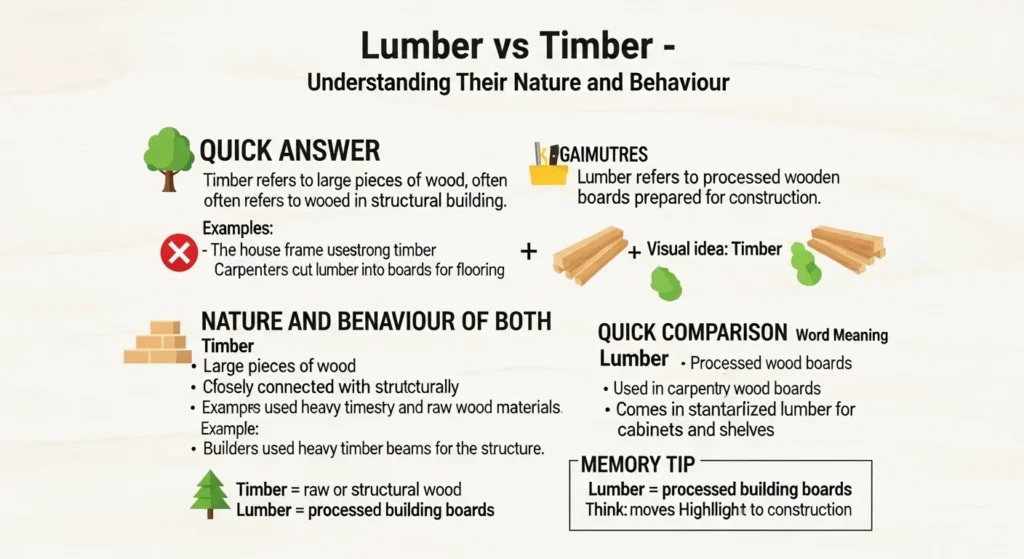
Timber
- Large pieces of wood
- Often used structurally
- Closely connected with forestry
Lumber
- Processed wood boards
- Used in carpentry and construction
- Standardized sizes
❓ Why People Are Confused About Their Use
People often confuse lumber and timber because both words refer to wood used in construction. In many everyday conversations, the terms are used interchangeably. Regional language differences also contribute to confusion. In some countries, the word timber is used broadly to describe wood materials, while in others lumber specifically refers to processed boards. Because both terms describe wood used in building, the distinction may seem subtle to beginners.
📋 Table: Difference and Similarity
| Feature | Lumber | Timber |
| Meaning | Processed wood boards | Large structural wood |
| Processing | Cut and shaped | Natural or large form |
| Size | Usually smaller | Usually larger |
| Use | Carpentry and furniture | Structural construction |
| Source | Sawmill production | Forest logs |
⚖️ Which Is Better in What Situation?
Timber
Timber is often better for heavy structural construction where large wooden beams or columns are required. Builders use it in frameworks, bridges, and major building supports because of its strength and size. Its natural structure allows it to carry significant loads.
Lumber
Lumber works best for carpentry, interior construction, and furniture making. Since it is processed into standard shapes and sizes, it is easier to cut, measure, and install. Builders commonly use lumber for flooring, walls, cabinets, and many household structures.
🎭 Use in Metaphors and Similes
Metaphor example:
- His leadership was the timber supporting the organization.
Simile example:
- The plan was arranged like carefully measured lumber in a workshop.
💬 Connotative Meaning
| Word | Connotation | Example |
| Timber | Strength, structure | The team needed a leader with strong timber. |
| Lumber | Craftsmanship, building | The project began with careful lumber planning. |
🗣️ Idioms or Expressions
Timber!
Meaning: a warning that a tree is falling.
Example:
- The workers shouted “Timber!” as the tree fell.
Expressions using lumber:
- The workers began to lumber across the yard with heavy tools.
📚 Works in Literature Related to Wood and Forestry
- “The Overstory” – Richard Powers, 2018
- “The Hidden Life of Trees” – Peter Wohlleben, 2015
- “Walden” – Henry David Thoreau, 1854
🎬 Movies Related to Forest and Wood Industry
- “The Emerald Forest” – 1985, United Kingdom
- “The Lorax” – 2012, USA
- “Princess Mononoke” – 1997, Japan
❔ Frequently Asked Questions
1. What is the main difference between lumber and timber?
Timber usually refers to large structural wood, while lumber refers to processed boards used in construction.
2. Is timber the same as wood?
Timber is a type of wood prepared or suitable for building purposes.
3. Where is lumber produced?
Lumber is produced in sawmills where logs are cut into boards.
4. Which is used for furniture?
Lumber is commonly used for furniture making.
5. Can timber become lumber?
Yes, timber logs can be processed in mills to produce lumber.
🌿 How Both Are Useful for Surroundings
Lumber and timber play important roles in construction, furniture production, and building infrastructure. Wood materials support housing, bridges, and everyday objects used by people. Responsible forest management ensures that timber resources remain sustainable while supplying lumber for construction and manufacturing.
✍️ Final Words for Both
Timber represents large structural wood often connected with forests and heavy construction.
Lumber represents processed wooden boards used in carpentry and building projects.
Both are essential materials in construction and wood industries.
🏁 Conclusion
Understanding the difference between lumber and timber helps people describe wood materials accurately in forestry and construction contexts.
Timber generally refers to large structural wood or logs suitable for building, while lumber refers to processed boards produced in sawmills.
Although the terms may sometimes appear interchangeable in casual conversation, their meanings differ in technical and industrial settings.
By recognizing how timber becomes lumber through processing, builders, students, and researchers can better understand how natural wood resources transform into useful construction materials.
Discover More Articles:

Hi, I’m Nabeel Hassan. I love exploring interesting topics and explaining how different things compare with each other. Through my writing, I aim to provide clear, helpful, and easy to read explanations. I cover subjects related to learning, science, technology and general knowledge.