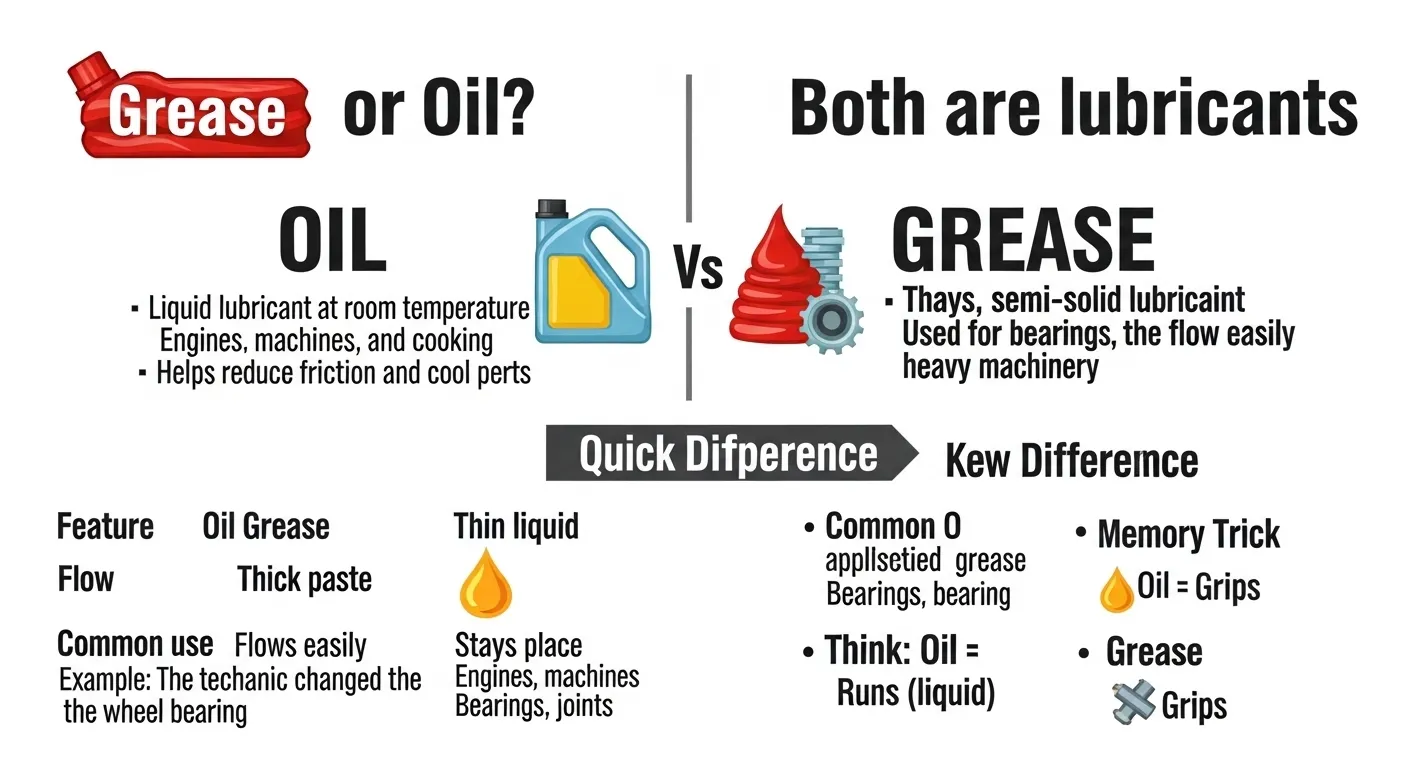
The difference between grease and oil is that oil is a liquid lubricant, while grease is a thicker, semi-solid lubricant made by combining oil with a thickening agent.
Imagine a mechanic repairing a machine in a workshop. For moving engine parts that need smooth flow, the mechanic adds oil.
For components that require a thick protective layer that stays in place, the mechanic applies grease. This simple situation explains why understanding the difference between grease and oil is important.
Many machines depend on proper lubrication, and knowing the difference between grease and oil helps people choose the right product to reduce friction, protect metal parts, and improve equipment performance.
🔑 Key Difference Between the Grease or Oil
The main difference is consistency and application.
- Oil is a thin liquid lubricant that flows easily.
- Grease is a thick semi-solid lubricant that stays in place.
Examples:
- Engines usually require oil to keep moving parts smooth.
- Bearings and joints often use grease to stay protected for longer periods.
🌍 Why Is Their Difference Necessary to Know?
Understanding the difference between grease and oil is important for engineers, mechanics, and anyone working with machines. Proper lubrication reduces friction, prevents damage, and increases the life of equipment. In industries such as manufacturing, transportation, and automotive repair, choosing the correct lubricant keeps machines running efficiently.
Students studying mechanical systems also learn this difference to understand how machines operate. In daily life, even simple devices like bicycles or door hinges require the right lubricant. Knowing when to use grease or oil helps prevent wear and improves the reliability of mechanical systems.
🔊 Pronunciation (US & UK)
| Word | US Pronunciation | UK Pronunciation |
| Grease | /ɡriːs/ | /ɡriːs/ |
| Oil | /ɔɪl/ | /ɔɪl/ |
➡️ Let us explore the detailed difference between grease and oil through clear explanations and examples.
📊 Difference Between Grease and Oil
1️⃣ Physical State
Oil exists in liquid form.
Grease has a thick semi-solid texture.
Examples:
- Engine oil flows easily through small spaces.
- Machine oil spreads quickly over metal parts.
Examples:
- Grease remains thick inside bearings.
- Lubrication grease stays attached to surfaces.
2️⃣ Composition
Oil is usually made from base oils or synthetic fluids.
Grease is oil mixed with a thickener and additives.
Examples:
- Mineral oil is used in engines.
- Synthetic oil improves lubrication in machines.
Examples:
- Lithium grease is common in automotive parts.
- Calcium grease protects metal components.
3️⃣ Flow Ability
Oil flows freely and spreads quickly.
Grease moves slowly and stays in place.
Examples:
- Hydraulic oil circulates in systems.
- Engine oil flows through channels.
Examples:
- Grease remains inside wheel bearings.
- Machinery grease stays on gears.
4️⃣ Application Method
Oil is usually poured or pumped into machines.
Grease is applied with tools such as grease guns.
Examples:
- Mechanics pour oil into engines.
- Lubrication oil is pumped into systems.
Examples:
- Grease is applied with a grease gun.
- Workers spread grease on moving joints.
5️⃣ Maintenance Frequency
Oil usually needs replacement more often.
Grease lasts longer without frequent changes.
Examples:
- Car engine oil needs periodic replacement.
- Industrial machines require regular oil checks.
Examples:
- Bearing grease lasts for longer periods.
- Some equipment uses long-life grease.
6️⃣ Cooling Ability
Oil can help remove heat from moving parts.
Grease mainly stays in place and provides protection.
Examples:
- Engine oil carries heat away from parts.
- Lubrication oil reduces temperature in engines.
Examples:
- Grease protects surfaces from wear.
- Thick grease seals machine components.
7️⃣ Sealing Ability
Oil has limited sealing ability.
Grease can act as a seal against dust and dirt.
Examples:
- Thin oil may leak from openings.
- Machinery oil requires sealed systems.
Examples:
- Grease blocks dust entry in bearings.
- Thick grease protects joints from contamination.
8️⃣ Operating Conditions
Oil works well in high-speed machinery.
Grease is better for slower or heavily loaded parts.
Examples:
- High-speed engines require oil lubrication.
- Turbines depend on oil flow.
Examples:
- Heavy equipment uses thick grease.
- Wheel bearings rely on grease.
9️⃣ Storage and Handling
Oil is stored in containers and poured easily.
Grease is stored in tubes or cartridges.
Examples:
- Machine oil comes in bottles.
- Industrial oil is stored in tanks.
Examples:
- Grease is sold in cartridges.
- Mechanics load grease into grease guns.
🔟 Typical Uses
Oil is used in engines and hydraulic systems.
Grease is used in bearings, gears, and joints.
Examples:
- Car engines depend on oil lubrication.
- Hydraulic machines use special oil.
Examples:
- Wheel bearings require grease.
- Mechanical joints often use grease.
🧠 Nature and Behaviour of grease and oil
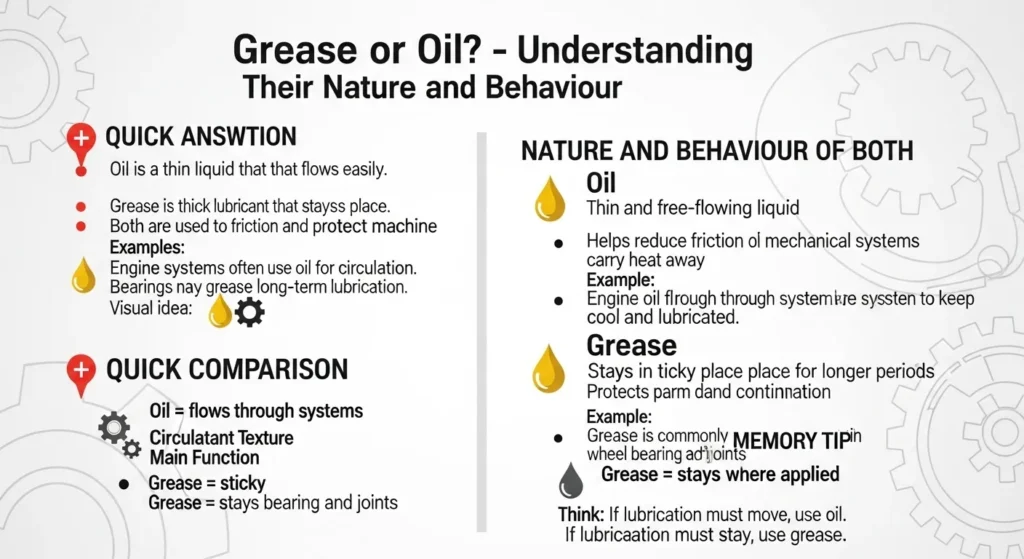
Oil
- Thin and free-flowing liquid
- Circulates through mechanical systems
- Helps reduce friction and carry heat away
Grease
- Thick and sticky lubricant
- Stays in one place for longer periods
- Protects parts from contamination
❓ Why People Are Confused About Their Use
Many people confuse grease and oil because both serve the same general purpose: reducing friction between moving parts. Since both are lubricants used in machines, beginners may think they can replace one with the other. In reality, their texture and function differ greatly.
Oil moves easily and works best where continuous flow is required, while grease remains in place and protects components that need long-lasting lubrication. Without understanding these characteristics, individuals may use the wrong lubricant, which can reduce machine efficiency or cause damage over time.
📋 Table: Difference and Similarity
| Feature | Grease | Oil |
| Physical State | Semi-solid | Liquid |
| Flow | Thick and slow | Thin and fast |
| Composition | Oil + thickener | Base oil or synthetic |
| Application | Grease gun or manual | Pouring or pumping |
| Cooling Ability | Limited | Good heat transfer |
| Typical Use | Bearings and joints | Engines and hydraulic systems |
⚖️ Which Is Better in What Situation?
Grease
Grease works best in situations where the lubricant must stay in place for a long time. Parts such as wheel bearings, gears, and mechanical joints benefit from grease because it creates a protective layer that does not easily leak away. Its thick texture also helps block dust and dirt from entering moving components. Machines operating under heavy loads or slower movement often rely on grease to maintain stable lubrication and reduce wear.
Oil
Oil is the better option when lubrication needs to flow freely through mechanical systems. Engines and hydraulic equipment depend on oil because it moves quickly and spreads evenly across moving parts. This liquid lubricant also helps carry heat away from components, which keeps machines operating smoothly. For high-speed systems where continuous circulation is necessary, oil provides efficient and reliable lubrication.
🎭 Use in Metaphors and Similes
Metaphor example:
- His calm advice was the oil that kept the team working smoothly.
Simile example:
- Their cooperation worked like grease in a machine.
💬 Connotative Meaning
| Word | Connotation | Example |
| Grease | Helpful support or facilitation | His donation helped grease the wheels of the project. |
| Oil | Smooth cooperation | Her friendly attitude oiled the conversation. |
🗣️ Idioms Related to These Words
Grease the wheels
Meaning: make something run smoothly.
Example:
- The manager’s planning helped grease the wheels of the project.
Oil the wheels
Meaning: make progress easier.
Example:
- Friendly communication helped oil the wheels of cooperation.
📚 Works in Literature Containing These Words
- “Oil!” – Novel, Upton Sinclair, 1927
- “The Prize: The Epic Quest for Oil, Money, and Power” – History, Daniel Yergin, 1991
- “Greasy Lake” – Short Story, T. C. Boyle, 1985
🎬 Movies Using These Words
- “There Will Be Blood” – 2007, USA (related to the oil industry)
- “Black Gold” – 2011, France/Qatar (oil exploration theme)
- “Grease” – 1978, USA
❔ Frequently Asked Questions
1. What is the main difference between grease and oil?
Oil is a liquid lubricant, while grease is a thick semi-solid lubricant.
2. Can grease replace oil in machines?
Not usually, because many machines require flowing liquid lubrication.
3. Why does grease stay longer on surfaces?
Because it contains a thickening agent that keeps it in place.
4. Which lubricant is better for engines?
Engines normally require oil for proper circulation.
5. Why do bearings often use grease?
Because grease provides long-lasting protection and sealing.
🌱 How Both Are Useful for Surroundings
Grease and oil play an important role in modern mechanical systems. They help machines operate smoothly by reducing friction and preventing wear. Industries such as transportation, manufacturing, and engineering depend on these lubricants to maintain equipment performance. Even simple tools and household devices benefit from proper lubrication, which improves durability and reliability.
✍️ Final Words for Both
Grease provides thick, long-lasting protection for mechanical parts.
Oil offers smooth and flowing lubrication for systems that require movement.
Together, they ensure machines operate efficiently and safely.
🏁 Conclusion
Understanding the difference between grease and oil helps individuals choose the correct lubricant for mechanical systems. Oil works best in situations where a liquid lubricant must circulate freely and remove heat from moving parts.
Grease, with its thicker texture, remains in place and provides long-lasting protection for components such as bearings and joints. Both substances serve essential roles in maintaining machinery and preventing wear. By learning their characteristics and applications, mechanics, engineers, and everyday users can improve equipment performance and extend the life of mechanical systems.
Discover More Articles:

I’m Owen Parker, and I write articles that focus on explaining the differences between common concepts, tools, and ideas. I enjoy simplifying complex information and turning it into clear comparisons that anyone can understand. My work often covers science , education, technology, and everyday knowledge topics.