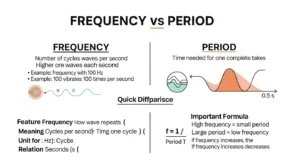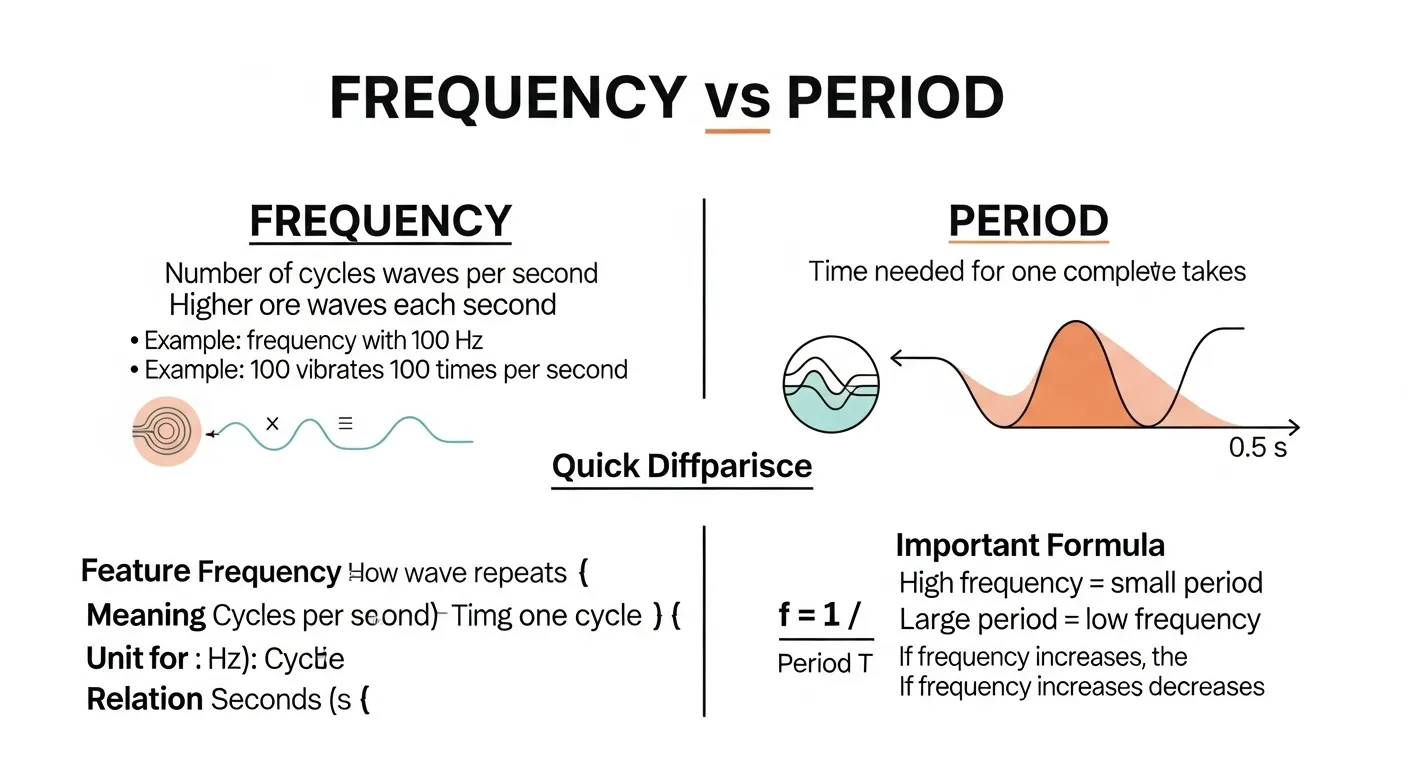
The difference between frequency and period is that frequency shows how many cycles occur in a second, while period shows the time required for one complete cycle.
Imagine a classroom demonstration where a teacher swings a pendulum back and forth. Students observe how often the pendulum completes a full swing in one second; that value represents frequency.
They also measure the time taken for one full swing, which represents the period. In many areas of Physics, understanding the difference between frequency and period helps explain waves, motion, and repeated events.
Learning the difference between frequency and period allows students and professionals to understand patterns that repeat over time.
🔑 Key Difference Between the Both
The main difference lies in what each term measures.
- Frequency: Number of cycles completed in one second.
- Period: Time required to complete one cycle.
Examples:
- A sound wave vibrating 50 times in a second has a frequency of 50 cycles.
- A rotating fan blade completing many turns each second shows frequency.
Examples:
- If one vibration takes 0.02 seconds, that value is the period.
- The time required for one swing of a pendulum is its period.
🌍 Why Is Their Difference Necessary to Know?
Understanding the difference between frequency and period is important in science and technology. Many systems around us involve repeating motion such as sound waves, light waves, and electrical signals. Scientists and engineers measure these patterns to design devices, analyze vibrations, and understand natural processes. Students studying Physics often learn the difference between frequency and period to understand how waves behave and how signals move through different systems. When people clearly understand this relationship, they can interpret data and analyze repeating events more effectively.
🔊 Pronunciation (US & UK)
| Word | US Pronunciation | UK Pronunciation |
| Frequency | /ˈfriːkwənsi/ | /ˈfriːkwənsi/ |
| Period | /ˈpɪriəd/ | /ˈpɪəriəd/ |
➡️ Now let us explore the detailed difference between frequency and period through clear explanations and examples.
🔬 Difference Between Frequency and Period
1️⃣ Definition
Frequency describes how many cycles occur in one second.
Period describes the time required for one cycle.
Examples:
- A wave repeating 10 times per second has a frequency of 10.
- A rotating machine producing many cycles shows high frequency.
Examples:
- If one cycle takes 0.1 seconds, that value is the period.
- A pendulum taking two seconds for a swing has a period of two seconds.
2️⃣ Measurement Unit
Frequency is measured in hertz (Hz).
Period is measured in seconds (s).
Examples:
- A radio signal may have a frequency of 100 Hz.
- Sound waves are often measured by frequency.
Examples:
- One oscillation lasting one second represents a period of 1 s.
- A repeating signal may have a period of 0.5 seconds.
3️⃣ Mathematical Relationship
Frequency equals the inverse of period.
Period equals the inverse of frequency.
Examples:
- If the period is 2 seconds, the frequency is 0.5 Hz.
- A wave repeating quickly has higher frequency.
Examples:
- If frequency is 4 Hz, the period becomes 0.25 seconds.
- Faster cycles reduce the period.
4️⃣ Focus of Measurement
Frequency focuses on repetition count.
Period focuses on time duration.
Examples:
- A machine producing many cycles shows higher frequency.
- Vibrating strings in music demonstrate frequency.
Examples:
- The time between two waves represents period.
- The duration of one full motion indicates period.
5️⃣ Representation in Waves
Frequency shows how many waves pass a point each second.
Period shows how long one wave lasts.
Examples:
- Sound waves traveling through air have measurable frequency.
- Musical tones differ by frequency.
Examples:
- One complete wave cycle represents a period.
- The interval between peaks indicates period.
6️⃣ Relation to Speed
Higher frequency often means more rapid vibration.
Longer period means slower cycles.
Examples:
- Fast vibrations produce high frequency.
- High-pitched sound relates to greater frequency.
Examples:
- Slow movement results in a longer period.
- A slowly swinging pendulum has a larger period.
7️⃣ Use in Wave Studies
Frequency helps analyze wave intensity and repetition.
Period helps analyze timing between cycles.
Examples:
- Engineers measure frequency in communication signals.
- Scientists observe frequency in vibration studies.
Examples:
- The period helps determine timing patterns.
- Repeating motion intervals reveal the period.
8️⃣ Graph Representation
Frequency relates to how closely waves appear on a graph.
Period relates to the spacing between repeating points.
Examples:
- Many waves close together indicate high frequency.
- Fewer waves suggest lower frequency.
Examples:
- Greater spacing between peaks indicates longer period.
- Short spacing shows a shorter period.
9️⃣ Use in Instruments
Frequency is commonly measured in sound and electronic devices.
Period appears in timing and motion measurements.
Examples:
- Radio transmitters measure frequency signals.
- Sound analysis often depends on frequency.
Examples:
- A stopwatch may help determine period.
- Motion experiments record period values.
🔟 Relationship to Motion
Frequency represents repeated motion rate.
Period represents motion duration.
Examples:
- A vibrating guitar string shows frequency.
- Rapid cycles indicate greater frequency.
Examples:
- The time for one vibration represents period.
- Slow oscillation shows a longer period.
🧠 Nature and Behaviour of frequency and period
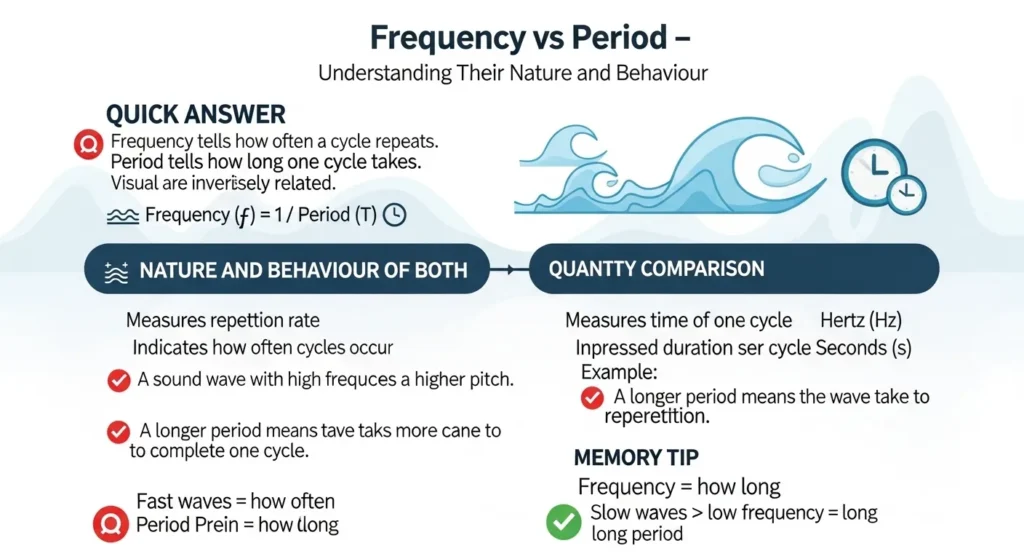
Frequency
- Measures repetition rate
- Expressed in hertz
- Indicates how often cycles occur
Period
- Measures time of one cycle
- Expressed in seconds
- Indicates duration of repetition
❓ Why People Are Confused About Their Use
Many people confuse frequency and period because both describe repeating events. They are closely connected through a mathematical relationship where one is the inverse of the other. Students sometimes focus on one measurement without realizing that both describe the same motion from different perspectives. Since both terms appear together in wave studies and physics formulas, it becomes easy to mix them up during learning.
📋 Table: Difference and Similarity
| Feature | Frequency | Period |
| Meaning | Cycles per second | Time for one cycle |
| Unit | Hertz (Hz) | Seconds (s) |
| Focus | Repetition rate | Time duration |
| Mathematical link | Inverse of period | Inverse of frequency |
| Application | Wave analysis | Motion timing |
⚖️ Which Is Better in What Situation?
Frequency
Frequency is more useful when measuring how often an event repeats in a given time. Engineers and scientists studying signals, sound waves, or electronic circuits frequently analyze repetition rates using frequency measurements. It provides a clear way to describe how rapidly cycles occur.
Period
Period becomes useful when focusing on the duration of a single event or cycle. In experiments involving oscillation or repeating motion, measuring the time for one complete cycle helps researchers analyze motion patterns and timing relationships.
🎭 Use in Metaphors and Similes
Metaphor example:
- His ideas appeared with the frequency of flashing lights.
Simile example:
- Her daily routine repeated like a steady period of motion.
💬 Connotative Meaning
| Word | Connotation | Example |
| Frequency | Activity or repetition | Messages arrived with high frequency. |
| Period | Completion or duration | The project marked a new period of learning. |
🗣️ Idioms or Expressions
Period.
Meaning: a statement used to emphasize finality or certainty.
Example:
- The rule must be followed, period.
📚 Works in Literature Using the Word Period
- “A Brief History of Time” – Stephen Hawking, 1988
- “The Elegant Universe” – Brian Greene, 1999
🎬 Movies Related to Scientific Waves
- “Interstellar” – 2014, USA
- “Contact” – 1997, USA
❔ Frequently Asked Questions
1. What is the main difference between frequency and period?
Frequency measures cycles per second, while period measures the time required for one cycle.
2. Are frequency and period related?
Yes, they are inversely related in wave and motion studies.
3. Which unit measures frequency?
Frequency is measured in hertz.
4. What unit measures period?
Period is measured in seconds.
5. Where are these concepts commonly used?
They are widely used in physics, wave analysis, and engineering studies.
🌍 How Both Are Useful for Surroundings
Frequency and period help people understand patterns that repeat in natural and technological systems. They assist in studying sound waves, vibrations, electronic signals, and mechanical motion. By measuring repetition and timing, scientists and engineers can analyze systems and improve many technologies used in daily life.
✍️ Final Words for Both
Frequency explains how often events repeat in a given time.
Period explains how long one repeating event lasts.
Both terms describe the same motion from different perspectives.
🏁 Conclusion
Understanding the difference between frequency and period provides a clear view of how repeating motion works in science and technology. Frequency focuses on how many cycles occur each second, while period measures the time required for one complete cycle.
These two concepts are closely connected through an inverse mathematical relationship, meaning when one increases the other decreases.
By learning how these terms interact, students and professionals can better interpret wave patterns, analyze motion, and understand repeating systems found in nature and technology.
Discover More Articles:

Hi, I’m Nabeel Hassan. I love exploring interesting topics and explaining how different things compare with each other. Through my writing, I aim to provide clear, helpful, and easy to read explanations. I cover subjects related to learning, science, technology and general knowledge.