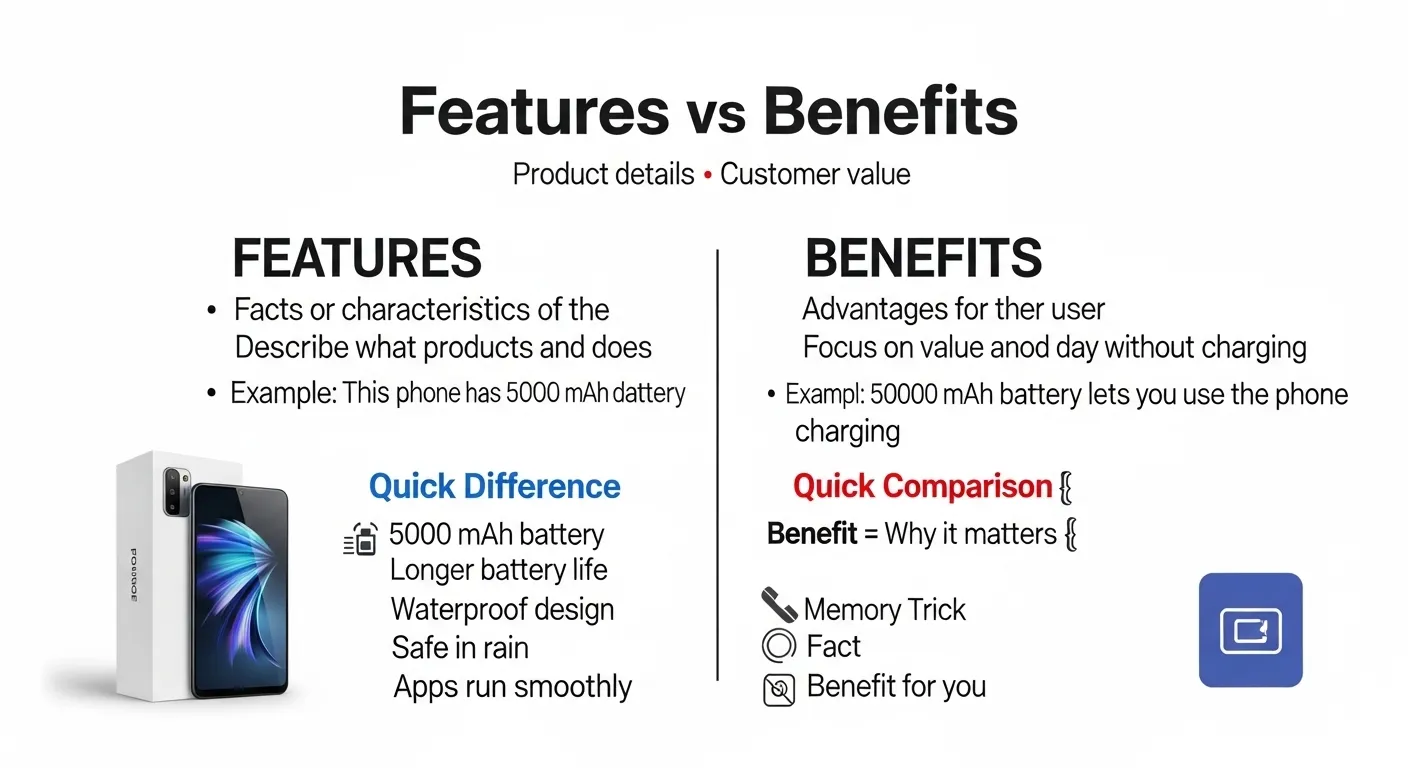
The difference between features and benefits is that features describe what a product or service has, while benefits explain how those features help the user.
Imagine a person buying a smartphone. The seller says the phone has a 5000 mAh battery and a high-resolution camera. These are features because they describe the product. Then the seller explains that the battery lasts all day and the camera captures clear photos. These are benefits because they show how the product improves the user’s experience.
Understanding the difference between features and benefits helps businesses explain products clearly and helps customers understand why a product is valuable.
🔑 Key Difference Between the Both
The main difference lies in description versus value to the user.
- Features describe the characteristics or qualities of a product or service.
- Benefits explain the advantages or value the user receives from those characteristics.
Examples:
- A laptop with 16 GB RAM is a feature.
- Faster performance while working on many tasks is the benefit.
🌍 Why Is Their Difference Necessary to Know?
Understanding the difference between features and benefits is important for businesses, professionals, and customers. When companies present a product, describing only its features may not clearly show why it matters to buyers. Explaining the benefits helps people see how the product can improve their daily lives or solve a problem. Students studying business, communication, or marketing also learn this concept to explain ideas clearly. In everyday conversations, understanding this difference helps people evaluate products and services more carefully before making decisions.
🔊 Pronunciation (US & UK)
| Word | US Pronunciation | UK Pronunciation |
| Features | /ˈfiːtʃərz/ | /ˈfiːtʃəz/ |
| Benefits | /ˈbenɪfɪts/ | /ˈbenɪfɪts/ |
➡️ Let us explore the detailed difference between features and benefits through clear explanations and examples.
📊 Difference Between Features and Benefits
1️⃣ Definition
Features describe the characteristics of a product or service.
Benefits explain how those characteristics help the user.
Examples:
- A car with airbags is a feature.
- A car with automatic transmission is another feature.
Examples:
- Airbags help protect passengers during accidents.
- Automatic transmission makes driving easier.
2️⃣ Focus
Features focus on the product itself.
Benefits focus on the user’s experience.
Examples:
- A laptop with large storage capacity is a feature.
- A phone with fast charging is a feature.
Examples:
- Large storage allows users to store many files.
- Fast charging saves time for the user.
3️⃣ Purpose
Features explain what the product includes.
Benefits explain why those features matter.
Examples:
- A watch with water resistance is a feature.
- A jacket with thermal insulation is a feature.
Examples:
- Water resistance allows the watch to work in wet conditions.
- Thermal insulation keeps the wearer warm in cold conditions.
4️⃣ Communication Style
Features often appear in product descriptions or specifications.
Benefits appear in explanations that highlight usefulness.
Examples:
- A smartphone with OLED display is a feature.
- A tablet with long battery life is a feature.
Examples:
- OLED display provides clear and vibrant images.
- Long battery life allows extended use without charging.
5️⃣ Customer Perspective
Features explain the product’s technical aspects.
Benefits explain the practical advantage for users.
Examples:
- A camera with 20-megapixel resolution is a feature.
- A vacuum cleaner with powerful motor is a feature.
Examples:
- High resolution produces sharp photographs.
- A powerful motor helps clean surfaces effectively.
6️⃣ Emotional Impact
Features usually provide factual information.
Benefits can create emotional appeal.
Examples:
- A chair with ergonomic design is a feature.
- A mattress with memory foam is a feature.
Examples:
- Ergonomic design reduces body discomfort.
- Memory foam provides comfortable sleep.
7️⃣ Role in Product Explanation
Features describe the structure or technology of a product.
Benefits explain the improvement to the user’s life.
Examples:
- A refrigerator with double-door design is a feature.
- A laptop with touchscreen display is a feature.
Examples:
- Double-door design allows better food organization.
- Touchscreen display enables easy interaction.
8️⃣ Language Used
Features use descriptive or technical language.
Benefits use practical and user-focused language.
Examples:
- A speaker with Bluetooth connectivity is a feature.
- A camera with image stabilization is a feature.
Examples:
- Bluetooth connectivity allows wireless music playback.
- Image stabilization produces clear photos without blur.
9️⃣ Decision Influence
Features inform people about the product.
Benefits help them decide why they should choose it.
Examples:
- A car with navigation system is a feature.
- A laptop with lightweight design is a feature.
Examples:
- Navigation helps drivers find routes easily.
- Lightweight design makes the laptop easy to carry.
🔟 Relationship Between Them
Features often lead to benefits.
Benefits explain the value created by features.
Examples:
- A phone with high-capacity battery is a feature.
- A camera with wide-angle lens is a feature.
Examples:
- High-capacity battery allows longer usage time.
- Wide-angle lens captures more area in photos.
🧠 Nature and Behaviour of features and benefits
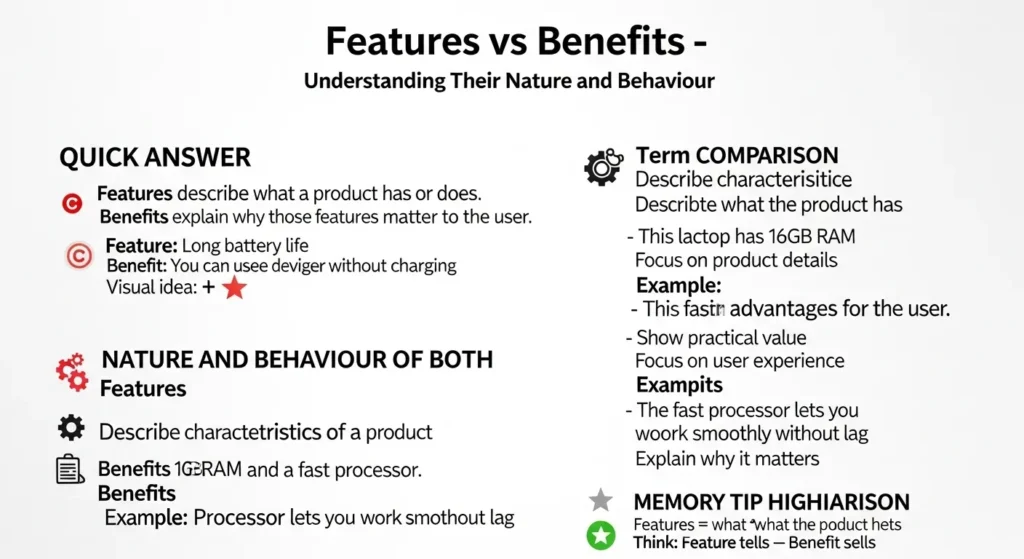
Features
- Describe characteristics of a product
- Often technical or descriptive
- Focus on product details
Benefits
- Explain advantages for the user
- Show practical value
- Focus on user experience
❓ Why People Are Confused About Their Use
Many people confuse features and benefits because both describe aspects of a product or service. When a product description mentions several characteristics, people may assume those characteristics automatically show value. In reality, features simply explain what exists, while benefits explain why those characteristics matter to the user. Without a clear explanation, readers may not understand how a feature improves their experience. This confusion often occurs when product descriptions focus too much on technical details without connecting them to real-life advantages.
📋 Table: Difference and Similarity
| Feature | Features | Benefits |
| Meaning | Characteristics of a product | Advantages for the user |
| Focus | Product details | User experience |
| Purpose | Describe what the product has | Explain why it is useful |
| Language | Technical or descriptive | Practical and user-focused |
| Role | Informational | Persuasive |
⚖️ Which Is Better in What Situation?
Features
Features are useful when people want to understand the technical characteristics of a product or service. Engineers, technicians, and informed buyers often examine features carefully to compare specifications between different options. These details help individuals evaluate the structure, design, and capabilities of a product before making a decision.
Benefits
Benefits are more effective when explaining why a product matters to users. They translate technical details into practical advantages that people can easily understand. When individuals learn how a product saves time, improves comfort, or solves a problem, they can see its real value and decide whether it suits their needs.
🎭 Use in Metaphors and Similes
Metaphor example:
- The new idea had many features, but its real benefit was the improvement it brought to the team.
Simile example:
- The plan worked like a machine whose features produced clear benefits.
💬 Connotative Meaning
| Word | Connotation | Example |
| Features | Neutral, descriptive | The phone’s features impressed the audience. |
| Benefits | Positive, advantageous | The benefits of the service helped many customers. |
🗣️ Idioms or Expressions
Direct idioms with these exact words are uncommon, though they appear frequently in professional communication.
Examples:
- The product offers many useful features.
- The program provides several benefits for students.
📚 Works in Literature Related to the Topic
- “Influence: The Psychology of Persuasion” – Robert Cialdini, 1984
- “The Copywriter’s Handbook” – Robert Bly, 1985
- “Made to Stick” – Chip Heath & Dan Heath, 2007
🎬 Movies Related to Business and Product Ideas
- “The Social Network” – 2010, USA
- “Joy” – 2015, USA
- “Steve Jobs” – 2015, USA
❔ Frequently Asked Questions
1. What is the main difference between features and benefits?
Features describe what a product has, while benefits explain how those features help the user.
2. Why are benefits important for customers?
Benefits show how a product improves convenience, efficiency, or comfort.
3. Can a feature also be a benefit?
A feature can lead to a benefit, but they represent different ideas.
4. Why do businesses explain both?
Because features show product details and benefits explain the value.
5. Which is more persuasive?
Benefits often influence decisions because they show practical advantages.
🌱 How Both Are Useful for Surroundings
Features and benefits play an important role in communication between businesses and customers. They help explain how products work and why they are useful. Clear explanations improve understanding and allow people to make informed choices when selecting products or services.
✍️ Final Words for Both
Features explain what a product includes.
Benefits explain how those features improve the user’s experience.
Together, they help people understand the value of products and services.
🏁 Conclusion
Understanding the difference between features and benefits helps people evaluate products and services more effectively. Features describe the characteristics or qualities of something, while benefits explain the advantages those characteristics provide to the user. Both are important because they work together to communicate value clearly.
Features give factual information about a product, and benefits translate those facts into practical usefulness. By recognizing how they relate, individuals can better understand product descriptions and make smarter decisions when comparing different options.

I’m Owen Parker, and I write articles that focus on explaining the differences between common concepts, tools, and ideas. I enjoy simplifying complex information and turning it into clear comparisons that anyone can understand. My work often covers science , education, technology, and everyday knowledge topics.