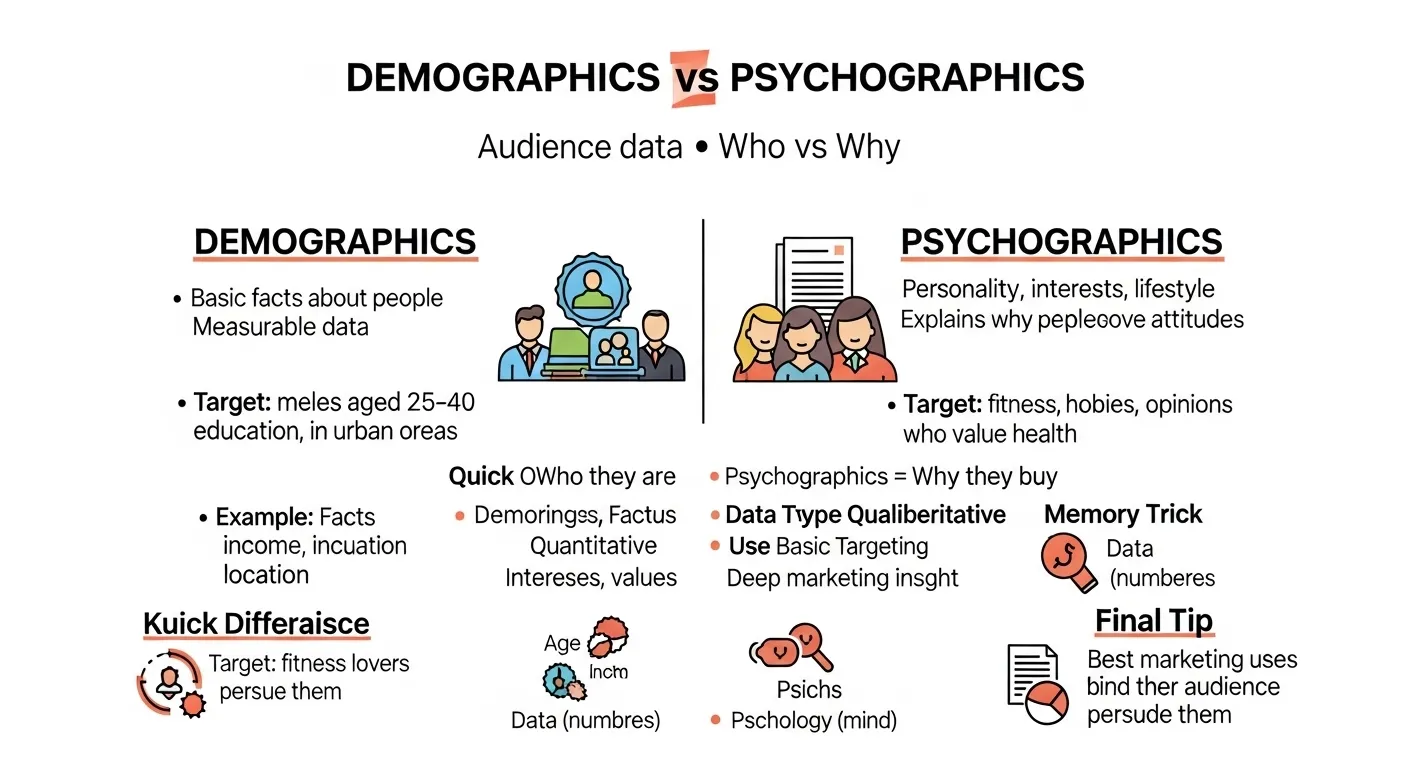
The difference between demographics and psychographics is that demographics describe who people are, while psychographics explain why they behave in certain ways.
Imagine a company studying its customers it may look at age, gender, or income, which are demographics. But if it studies interests, values, and lifestyle choices, that is psychographics. Understanding the difference between demographics and psychographics helps businesses and individuals better understand audiences.
Knowing the difference between demographics and psychographics also improves communication, decision-making, and how products or ideas are presented to people.
🔑 Key Difference Between the Both
The main difference lies in type of information.
- Demographics: Basic statistical data about people.
- Psychographics: Insights into attitudes, interests, and behavior.
Examples:
- Demographics include age and income.
- It describes groups.
Examples:
- Psychographics include hobbies and values.
- It explains behavior.
🌍 Why Is Their Difference Necessary to Know?
Understanding the difference between demographics and psychographics is important in modern communication and business. Relying only on demographics gives surface-level information, while psychographics provides deeper understanding. Knowing the difference between demographics and psychographics helps create better strategies, connect with audiences, and improve outcomes in marketing, education, and research. It allows people to understand not just who others are, but also what they think and feel.
🔊 Pronunciation (US & UK)
| Word | US Pronunciation | UK Pronunciation |
| Demographics | /ˌdɛməˈɡræfɪks/ | /ˌdɛmɒˈɡræfɪks/ |
| Psychographics | /ˌsaɪkoʊˈɡræfɪks/ | /ˌsaɪkəʊˈɡræfɪks/ |
➡️ Now let us explore the detailed difference between demographics and psychographics step by step.
📊 Difference Between Demographics and Psychographics
1️⃣ Definition
Demographics describe population data.
Psychographics describe mindset and behavior.
Examples:
- Demographics include age groups.
- It shows numbers.
Examples:
- Psychographics include personality.
- It shows thinking patterns.
2️⃣ Data Type
Demographics are quantitative.
Psychographics are qualitative.
Examples:
- Demographics use statistics.
- It includes numbers.
Examples:
- Psychographics use opinions.
- It includes feelings.
3️⃣ Focus
Demographics focus on identity.
Psychographics focus on lifestyle.
Examples:
- Demographics show who people are.
- It identifies groups.
Examples:
- Psychographics show how people live.
- It explains choices.
4️⃣ Examples
Demographics include age, gender, income.
Psychographics include interests, values, beliefs.
Examples:
- Demographics show population segments.
- It is measurable.
Examples:
- Psychographics show preferences.
- It is descriptive.
5️⃣ Purpose
Demographics help categorize people.
Psychographics help understand behavior.
Examples:
- Demographics group customers.
- It organizes data.
Examples:
- Psychographics explain decisions.
- It reveals motivation.
6️⃣ Usage
Demographics are used in surveys.
Psychographics are used in analysis.
Examples:
- Demographics are collected easily.
- It is simple.
Examples:
- Psychographics need deeper research.
- It takes time.
7️⃣ Depth
Demographics provide surface-level insight.
Psychographics provide deep insight.
Examples:
- Demographics give basic facts.
- It is general.
Examples:
- Psychographics give detailed understanding.
- It is specific.
8️⃣ Application
Demographics are used in planning.
Psychographics are used in targeting.
Examples:
- Demographics help identify groups.
- It supports planning.
Examples:
- Psychographics help tailor messages.
- It improves connection.
9️⃣ Accuracy
Demographics are more precise.
Psychographics may vary.
Examples:
- Demographics are factual.
- It is reliable.
Examples:
- Psychographics depend on opinions.
- It can change.
🔟 Complexity
Demographics are simple to understand.
Psychographics are more complex.
Examples:
- Demographics are easy to measure.
- It is straightforward.
Examples:
- Psychographics require analysis.
- It is detailed.
🧠 Nature and Behaviour of Demographics and Psychographics
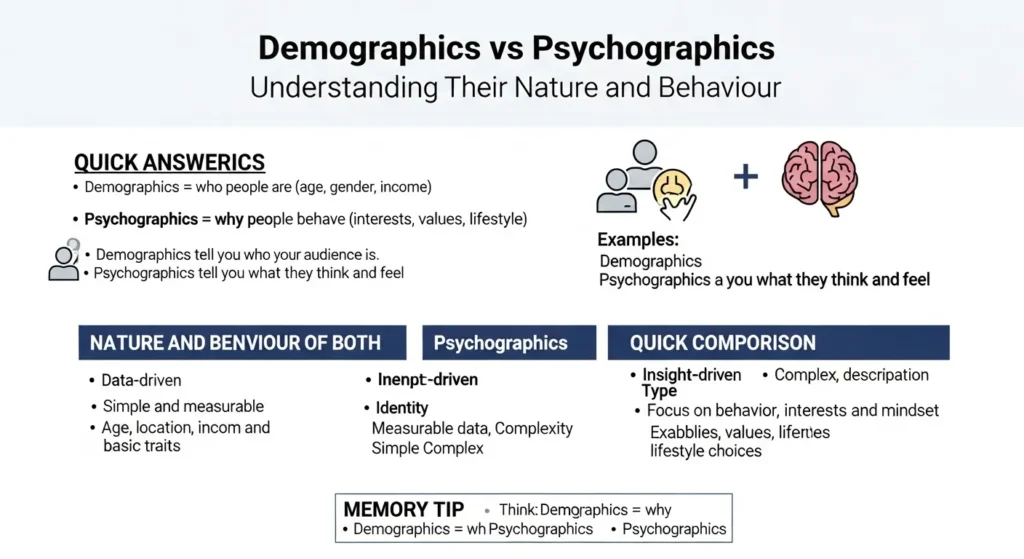
Demographics
- Data-driven
- Simple and measurable
- Focus on identity
Psychographics
- Insight-driven
- Complex and descriptive
- Focus on behavior
❓ Why People Are Confused About Their Use
People often confuse demographics and psychographics because both are used to understand groups of people. They may seem similar since both involve analyzing audiences. The confusion becomes clear when understanding that demographics focus on facts, while psychographics focus on thoughts and behaviors.
📋 Table: Difference and Similarity
| Feature | Demographics | Psychographics |
| Type | Quantitative | Qualitative |
| Focus | Identity | Behavior |
| Data | Statistics | Attitudes |
| Depth | Basic | Deep |
| Use | Grouping | Understanding |
⚖️ Which Is Better in What Situation?
Demographics
Demographics are better when you need quick and clear information about a group. They are useful for identifying target audiences and making general decisions.
Psychographics
Psychographics are better when you want to understand behavior and motivations. They help create stronger connections and more personalized strategies.
🎭 Use in Metaphors and Similes
Metaphor example:
- Demographics are the skeleton of data.
Simile example:
- Psychographics are like the heart, full of meaning.
💬 Connotative Meaning
| Word | Connotation | Example |
| Demographics | Structure, data | The report felt like demographics. |
| Psychographics | Insight, emotion | The study felt like psychographics. |
🗣️ Expressions
Examples:
- Know your demographics
- Understand psychographics deeply
📚 Works in Literature
- “Consumer Behavior” – Leon Schiffman, 2010
- “Buyer Personas” – Adele Revella, 2015
🎬 Movies Related to Human Behavior
- “Inside Out” – 2015, USA
- “The Social Dilemma” – 2020, USA
❔ Frequently Asked Questions
1. What is the main difference between demographics and psychographics?
Demographics describe who people are, while psychographics explain why they behave.
2. Which is more important?
Both are important for full understanding.
3. Are demographics enough?
No, they lack deeper insight.
4. Why use psychographics?
To understand motivations and behavior.
5. Can both be used together?
Yes, they work best together.
🌍 How Both Are Useful for Surroundings
Demographics and psychographics help businesses, researchers, and educators understand people better. They improve communication, planning, and decision-making in society.
✍️ Final Words for Both
Demographics represent data and identity.
Psychographics represent insight and behavior.
Both are essential for understanding people.
🏁 Conclusion
Understanding the difference between demographics and psychographics helps people analyze audiences more effectively. Demographics provide basic data, while psychographics offer deeper insights into behavior and motivation.
Together, they create a complete picture of individuals and groups. Learning this difference improves communication and decision making in many areas.
Discover More Articles:

I’m Owen Parker, and I write articles that focus on explaining the differences between common concepts, tools, and ideas. I enjoy simplifying complex information and turning it into clear comparisons that anyone can understand. My work often covers science , education, technology, and everyday knowledge topics.