The difference between citation and reference is that a citation appears inside the text to show where an idea came from, while a reference gives the full source details at the end of a document.
Imagine a student writing a research paper. While explaining an idea from a book, the student mentions the author’s name and year within the sentence. That short acknowledgment is a citation.
At the end of the paper, the student lists the complete information about that book, including title, publisher, and year. That detailed entry is a reference.
Understanding the difference between citation and reference helps writers present information clearly and give proper credit to original authors.
🔑 Key Difference Between the Both
The main difference lies in where and how the source information appears.
- Citation: A brief mention of a source within the text.
- Reference: A full description of the source listed at the end of the document.
Examples:
- A sentence might include (Smith, 2020) as a citation.
- The full book information appears later in the reference list.
🌍 Why Is Their Difference Necessary to Know?
Understanding the difference between citation and reference is important for students, researchers, and writers. Academic writing depends on clear acknowledgment of ideas and information taken from other sources. Citations allow readers to quickly see where an idea originated, while references provide the detailed information needed to locate that source. This practice supports transparency and intellectual honesty in research and education. It also helps readers verify facts, explore additional material, and build knowledge from reliable sources.
🔊 Pronunciation (US & UK)
| Word | US Pronunciation | UK Pronunciation |
| Citation | /saɪˈteɪʃən/ | /saɪˈteɪʃən/ |
| Reference | /ˈrefərəns/ | /ˈrefərəns/ |
➡️ Let us explore the detailed difference between citation and reference with clear explanations and examples.
📊 Difference Between Citation and Reference
1️⃣ Definition
A citation is a short acknowledgment within the text.
A reference is a complete source entry at the end of the document.
Examples:
- (Johnson, 2018) is a citation.
- (Brown & Lee, 2021) is another citation.
Examples:
- Johnson, A. (2018). Modern Research Methods. is a reference.
- Brown, L. & Lee, P. (2021). Academic Writing Guide. is another reference.
2️⃣ Location in a Document
A citation appears inside the text.
A reference appears in a reference list or bibliography.
Examples:
- The study showed strong results (Clark, 2019).
- Recent research supports this claim (Miller, 2022).
Examples:
- Clark, D. (2019). Education Trends.
- Miller, T. (2022). Research Approaches.
3️⃣ Length of Information
A citation contains brief information.
A reference contains full publication details.
Examples:
- (Adams, 2017) is a brief citation.
- (Garcia, 2020) is another short citation.
Examples:
- Adams, R. (2017). Learning Strategies. Publisher name.
- Garcia, L. (2020). Academic Communication.
4️⃣ Purpose
A citation shows which source supports an idea.
A reference allows readers to locate the source.
Examples:
- The theory was widely discussed (Smith, 2015).
- Another study confirmed the findings (Chen, 2019).
Examples:
- Smith, J. (2015). Theory and Practice.
- Chen, W. (2019). Research Development.
5️⃣ Format Style
A citation follows a short format depending on the writing style.
A reference follows a detailed formatting style.
Examples:
- (Taylor, 2020) in one style.
- (Taylor & Green, 2020) in another style.
Examples:
- Taylor, K. (2020). Research Basics.
- Taylor, K., & Green, S. (2020). Writing Techniques.
6️⃣ Number in a Document
A document may contain many citations throughout the text.
The reference list collects all those sources in one place.
Examples:
- Several paragraphs include different citations.
- Each idea may include a citation.
Examples:
- The reference section lists every source used.
- Each source appears once in the reference list.
7️⃣ Detail Level
A citation includes minimal information.
A reference includes detailed information.
Examples:
- (Wilson, 2016) is minimal information.
- (Ahmed, 2019) is another brief citation.
Examples:
- Wilson, R. (2016). Study Skills.
- Ahmed, S. (2019). Academic Research.
8️⃣ Reader Function
A citation helps readers quickly identify the source.
A reference helps readers find the full source.
Examples:
- Readers notice the citation while reading.
- It signals the origin of an idea.
Examples:
- Readers check the reference list for details.
- It provides full publication information.
9️⃣ Relationship
A citation usually corresponds to a reference entry.
Examples:
- (Martin, 2021) appears in the text.
- Another citation may appear later.
Examples:
- Martin, P. (2021). Research Analysis. appears in references.
- Each citation matches a reference entry.
🔟 Placement Style
A citation may appear in parentheses or within sentences.
A reference appears in a structured list.
Examples:
- The author argues this idea (Davis, 2020).
- Another claim appears in the text (Kim, 2018).
Examples:
- Davis, L. (2020). Modern Learning.
- Kim, H. (2018). Education Methods.
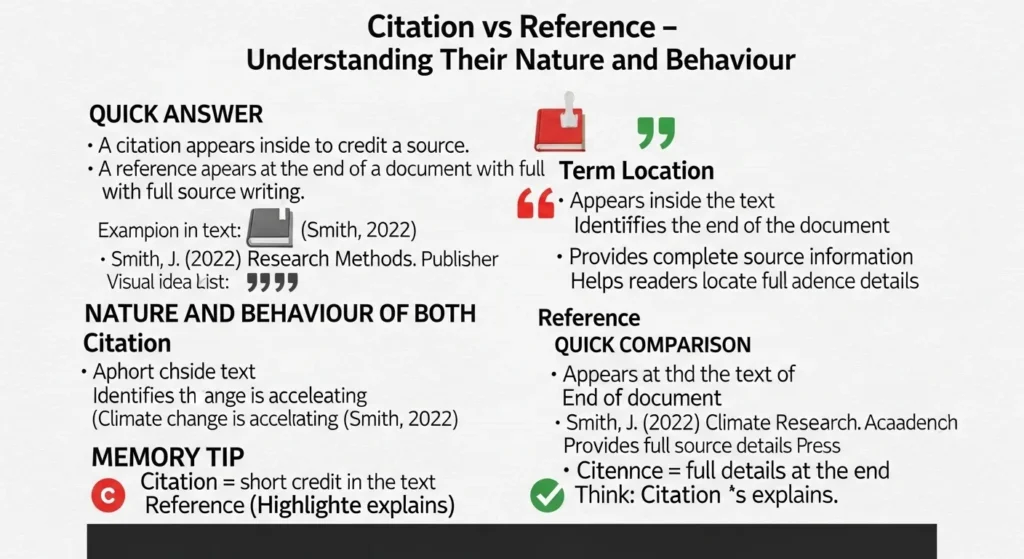
🧠 Nature and Behaviour of citation and reference
Citation
- Appears inside the text
- Short and brief
- Identifies the source of an idea
Reference
- Appears at the end of the document
- Provides complete source information
- Helps readers locate the source
❓ Why People Are Confused About Their Use
Many people confuse citation and reference because both relate to acknowledging sources in writing. Beginners often assume the short mention in the text already includes all necessary information. In reality, the citation only signals the source, while the reference provides the complete details. Since both appear in the same document and work together, the difference may seem subtle at first. Learning their roles helps writers organize research clearly and present information properly.
📋 Table: Difference and Similarity
| Feature | Citation | Reference |
| Meaning | Short mention of a source | Full description of the source |
| Location | Inside the text | End of document |
| Detail Level | Brief | Detailed |
| Purpose | Show source in text | Provide full information |
| Function | Acknowledgment | Source identification |
⚖️ Which Is Better in What Situation?
Citation
A citation is important while presenting ideas inside a paragraph or discussion. It quickly informs readers that the information comes from another source. Writers use citations to connect statements with supporting research without interrupting the flow of the text.
Reference
A reference becomes essential when readers want detailed information about a source. It provides complete publication details such as the author, title, and year. This allows readers to locate the original material and explore the topic further.
🎭 Use in Metaphors and Similes
Metaphor example:
- A citation is like a signpost pointing toward knowledge.
Simile example:
- A reference list works like a library map guiding readers to sources.
💬 Connotative Meaning
| Word | Connotation | Example |
| Citation | Academic acknowledgment | The paper included many citations. |
| Reference | Reliable source record | The reference list helped locate the book. |
🗣️ Expressions Related to the Words
Examples:
- Provide proper citation for every borrowed idea.
- Check the reference list for complete information.
📚 Works in Literature About Academic Writing
- “They Say / I Say” – Gerald Graff & Cathy Birkenstein, 2006
- “Writing Research Papers” – James D. Lester, 2009
- “The Craft of Research” – Wayne C. Booth, 2008
🎬 Movies Related to Academic or Research Themes
- “The Theory of Everything” – 2014, United Kingdom
- “A Beautiful Mind” – 2001, USA
- “Good Will Hunting” – 1997, USA
❔ Frequently Asked Questions
1. What is the main difference between citation and reference?
A citation appears within the text, while a reference provides full details at the end.
2. Do all citations need references?
Yes, each citation should correspond to a reference entry.
3. Why are citations important in research?
They show where information or ideas originated.
4. Where are references placed?
They appear at the end of a document in a reference list.
5. Can a reference exist without a citation?
Usually references correspond to citations within the text.
🌱 How Both Are Useful for Surroundings
Citations and references help maintain honesty and accuracy in writing. They ensure that authors receive credit for their ideas and allow readers to explore original research. This system supports knowledge sharing in education and research communities.
✍️ Final Words for Both
Citation identifies the source of an idea inside the text.
Reference provides the complete information about that source.
Together they help writers present research responsibly.
🏁 Conclusion
Understanding the difference between citation and reference helps writers organize research clearly and give credit to original authors. A citation provides a short acknowledgment within the text, showing where an idea originated. A reference offers the complete details of that source at the end of the document.
Both elements work together to maintain clarity, reliability, and academic integrity in writing. By learning how to use citations and references properly, students and researchers can present their work in a structured and trustworthy way.
Discover More Articles:

I’m Owen Parker, and I write articles that focus on explaining the differences between common concepts, tools, and ideas. I enjoy simplifying complex information and turning it into clear comparisons that anyone can understand. My work often covers science , education, technology, and everyday knowledge topics.